Showing posts with label Historical Significance. Show all posts

Saturday, October 15, 2011

Premo Camera - HS 034


HS 034
Film Premo No. 1
Era: 1900's
Details: Eastman Kodak

And to wrap up the mass celebration posts celebrating one year of the Sholesonian we have my personal favorite camera in the History and Cultural Collection: an Eastman Kodak The Premo Camera Film No. 1. Produced back in 1906 this camera utilized 3 1/4 x 4 1/4 sheet film. This meant that only one picture could be taken at a time. This camera was designed by Kodak more for amateur photographers of the day and was a bit more budget friendly. The camera has a variety of scales for determining which distance to pull it out and how to set the lens depending on brightness to allow amateurs the ability to take good photographs without needing to know all the references that the professionals did. 

While it may be surprising today, when this camera first came out over a century ago it was one of the most convenient cameras on the market. Lightweight and compact (the billows folds right up into the box) made it easy to use. It features two tripod sockets, one for landscape and the other for portrait. This particular specimen has lost the strap handle and the pump thing (I apologize I don't know what it's called) for taking a picture. 

This camera was one of the many models used by George Eastman in revolutionizing the photographic world. Kodak would become a powerhouse and household name for cameras and film. This early model was one that popularized public use of cameras at home and made it more affordable and portable for the average user. Scroll down this site to learn more about these Kodak Film Premo No. 1 cameras. 

Tuesday, July 5, 2011

Grand Ol' Flag - HS 048


HS 048
American Flag
Era: 1960's 
Details: 48 stars

Happy Independence Day! Browsing through the Sholesonian collections I was trying to decide what would be a great piece to post that celebrates the United States on it's 235 birthday and what better than the old American Flag. This is one of the more prominent permanent displays at the Sholesonian, but what makes it so special? Well, count the stars. That's right this is an original 48 star flag, framed in all its glory (you can see George Washington in the corner on a quarter for scale). For those who are a bit rusty on their American history, the current 50 star flag came into being after Hawaii finally declared statehood after Alaska back in 1959. 

Back in 2003 my grandparents were selling their large estate to move into more manageable housing and you may not know this but the Sholesonian has its roots in this house. My grandfather had turned the 2nd floor in a three story barn into a small personal museum, displaying all old stuff he had collected over the years being both a businessman and a farmer. This inspired me and has evolved into the current site you're reading. But the top floor of this barn had a half basketball court where my cousins and I would play when we came over. At the peak of the court hung this flag and while no one payed any attention to this dirty ragged old flag I managed to catch a glimpse and noticed it had 48 stars in the closing moments before I would leave the barn for good. So my grandpa took out the ladder, took it down, gave it to my mother to clean (it nearly disintegrated hitting the water), it was repaired a little, framed, and given to me for my birthday years ago. And as it turns out it was my father who placed this up in the barn back when he was a young kid. 

On the back of the frame reads: 
"Barn Ball Flag"
Placed in Peak of Barn at Sholestead,
Sennett, N.Y. by David G. Sholes
around 1965. Retrieved by Steven F.
Sholes upon sale of Sholestead in July 
2003.

The 48 star flag was used for 47 years and is the second longest used flag in American history, with the current 50 star flag beating it out. It first came in use in 1912 after the incorporation of Arizona and New Mexico into the Union (There was no 47 star flag but a 49 star flag was used for a year). It's also interesting to note that there are already flag proposals for flags up to 56 stars for any case in which some territories of the United States reach statehood (such as Puerto Rico, Washington D.C., New York City, etc.), and you can learn more about the history of the US flag here. And I also suggest you hop on over to the Smithsonian site to check out THE original Star Spangled Banner - the one Francis Scott Key saw still waving over the fort and wrote the song from. 

Thursday, June 23, 2011

Mercury and Leeches - HS 033


HS 033
Pill Box?
Era: Late 19th Century
Details: Rochester, NY

Wow, this one took awhile to research. While you can't see the whole thing in too much detail, this is a small what I believe to be a pill box made out of a light cardboard-like material. The box has some red covering over it which has severely deteriorated over time but the label on the lid (pictured) is still in great condition. What you can read on the top is "Lane & Paine; Apothecaries; 18 Buffalo St.; Rochester, N.Y.". I can't make out what the label for the contents of the box is (to me it looks like a decaying wave function), but there is an i in it. You will have to disregard the number '14564' as it was used to describe what was put in it much later. 

After digging deep into the internet, I've come up with an approximate timeline for this guy, though I'm not 100% on the sources. I managed to find a site about Landmarks of Monroe County which says that the Paine Drug Store was moved from its location (not mentioned) to a new street in 1878 where it was renamed from Lane & Paine (both of who took over the store in 1852) to C. F. Paine & Co.. This drug store is the oldest in Rochester, NY having been originally founded in 1820. Now finding a Rochester City Hospital review/newsletter of sorts I found an ad for the apothecary from 1869 which is right when it was called Lane & Paine. If you check page 16 of the Rochester City Hospital  review you will see their advertisement which reads "Lane & Paine, Dealers in Drugs, Medicines, Chemicals, Toilet Articles, Perfumery, &c.; 18 Buffalo St., Rochester, N.Y.; Alfred S. Lane, mch, 1866. 1y, Cyrus F. Paine." 

As you can see this date the pill box to between 1852 and 1878 if all of this is correct. Now you may be wondering what an apothecary exactly is. You probably got from the ad that they are some sort of pharmacist-like professionals. This is because apothecaries where the precursors to modern day pharmacies, though they were a bit different. Unlike pharmacists today, many apothecaries would also act like physicians performing operations, looking and diagnosing patients, preparing and selling drugs and medicines, performing procedures that would be considered medieval in today's standards, and selling things like tobacco and homemade remedies. This includes prescribing leeches to drain blood from patients who had 'too much' and hanging drowning victims by their feet from trees and pulling them up and down. Their main tools of the trade were the famous mortar and pestles used for mixing and grinding herbs to make medicines and would even go so far to prescribe mercury to patients. There is much much more information available at this apothecary website which will give an in-depth look into the lives of these practitioners, I encourage you all to have a look. 

Tuesday, June 7, 2011

Pepsi Cola Logo - HS 012


HS 012
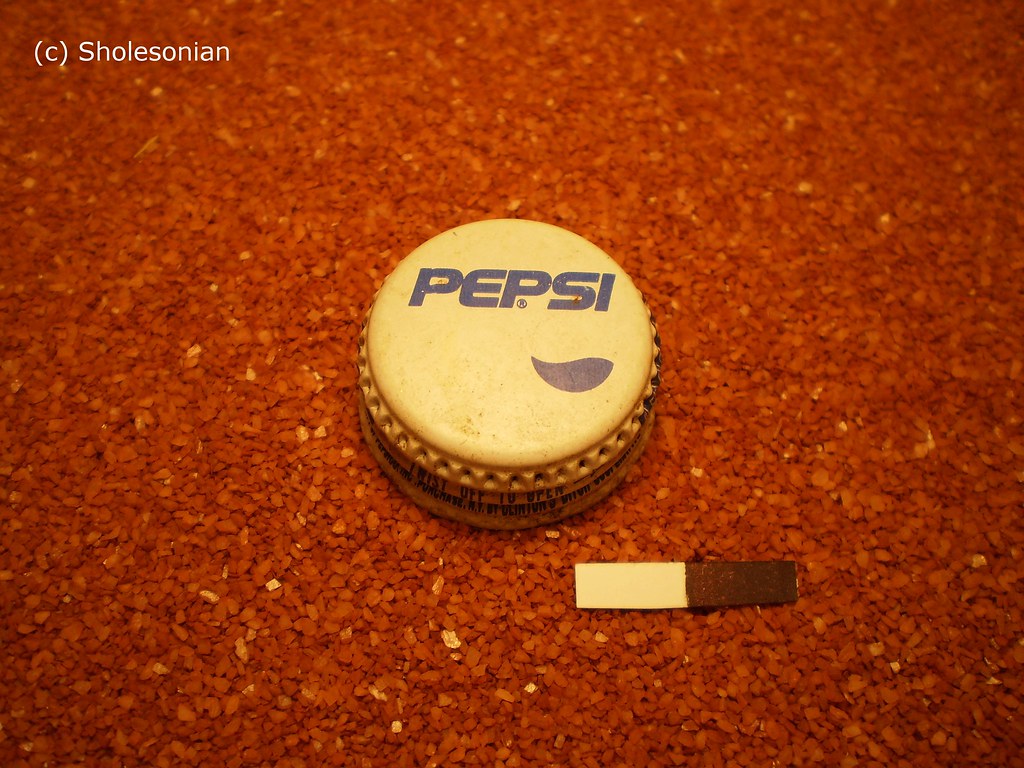
Pepsi Cap
Era: 1990's
Details: red coloring gone

And a final post for today from the last collection: Historical and Cultural Significance. Now I learned a bit doing just a tad research about the history of the Pepsi logo. This particular specimen was found on the shore of Sampson State Park, New York back in the mid 2000's. When I first found it, it looked a bit older however upon further inspection it looks relatively newish. As it turns out this particular logo design was created in 1991 and Pepsi wouldn't change it until 1998, thus this cap came from a bottle somewhere in this time frame. 

You can see in the photo that the weathering from Seneca Lake and the sun over the years has taken its toll and erased the red from the logo. However you can clearly see what the design would have looked like in brand new condition. Check out this chart from FlowingData where they analyzed the changing logos of both Pepsi-Cola and Coca-Cola products. Pepsi's logo has changed quite a bit since 1898 but Coca-Cola has stayed relatively stagnant since 1885. Also, on the side of the twist-top bottle top, it says that the soda was manufactured in Cicero, New York. 

Be sure to like our Facebook page and stayed tuned for a summer of updates! 

Friday, April 8, 2011

Old Spice - HS 032


HS 032
Old Spice Bottle
Era: 1950's
Details: needs to be restored

Long before Isaiah Mustafa had his claim to fame in now popular Old Spice Commercials, Old Spice had a slightly different set of products. Originally a Shulton Company fragrance for women, it later turned into products for men, including aftershave and shaving soap. This was the case from 1938 until 1990 when the company was purchased by Proctor and Gamble where not only was the trademarked changed from the traditional sailing ship to a more streamlined yacht, but also expanded their products to include deodorants, body wash, and sprays. 

Awhile back I found this bottle slightly buried in my backwoods, probably thrown out by some previous owners before the modern day waste-removal systems. As you can see this is an older bottle, due to the classic brand design and bottle form, and is After Shave Talcum powder instead of the traditional After Shave Lotion. Doing a little bit of research I find that this most closely resembles the 1956 glass bottle form due to its shape. And although it is missing the distinctive bottle stopper which would give a more accurate date to it, the design and writing seems to do the trick. 

Monday, March 21, 2011

Embroidery Crane - HS 031


HS 031
Embroidery Scissors
Era: 19th or 20th Century
Details: Crane

This next piece is a bit hard to determine the origin and era than most of the other historical/cultural specimens. Doing a little bit of research I've found a bunch of similar types of small scissors in the crane shape, however they all have identifying marks on the inside of the scissors, whereas this pair only has two horizontal marks. Many of these other scissors were made in Germany, although I've found at least one similar looking pair made in Russia. Although there seems to be an abundance of this style of scissors there doesn't seem to be any sort of date associated with them. This pair was donated by my grandmother so as of right now they could be from early-mid 20th century perhaps earlier due to the elegant design, but this is purely speculative.

You may be wondering what these scissors are if you're unfamiliar with home economics. This is a pair of embroidery scissors, so they were used in decorating fabrics, making small cuts and for cutting the thread etc. The color has begun to degrade in some spots and the screw (which makes the crane's eyeball) is a bit loose, but otherwise the scissors aren't in that bad of shape. If you're interested in embroidery check out this page to learn about its history and other useful information. 

Saturday, March 12, 2011

Pocket Pics - HS 006


HS 006
Argus Carefree Pocket Camera
Era: Late 20th Century
Details: 110 film

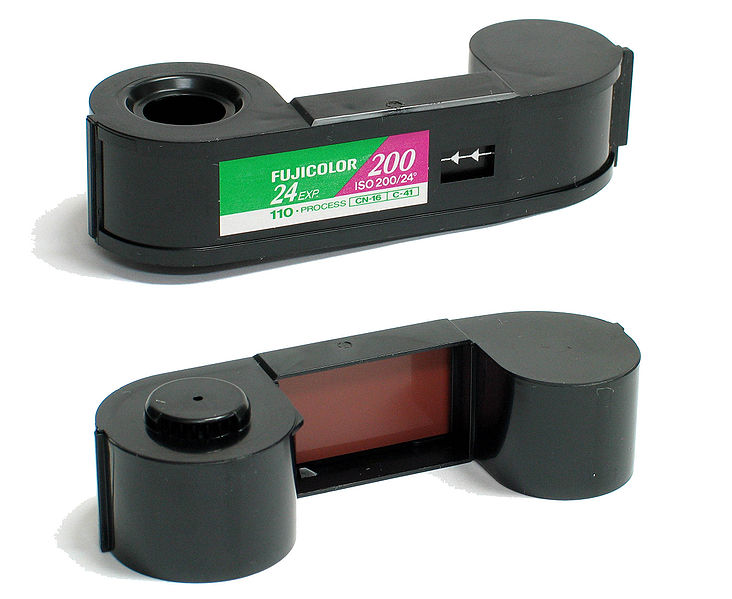
Another of my old cameras for your enjoyment. This one however was quite difficult to find any supplementary information about. It's an Argus brand 110 Carefree 2 Pocket Camera. If you're unfamiliar with what 110 film looks like check out the link. Since there is hardly an identifying feature on the camera at all, and because there seems to be hardly any information available online I'm assuming that this was made in the late 20th century, probably late 1970's or 1980's. I managed to find this Popular Mechanics issue that shows the rise of cheap 110 film cameras booming during the 1970's which is why I'm inclined to go with this temporary date. 

As you can see from the picture there seems to be a small scratch on the front in the shape of the Greek letter lambda. You may also notice that there is no flash on the camera. This was because the camera was meant to be kept easily in your pocket and flashes would add weight/bulk/price to the camera. The lens on the far left of the picture is the viewfinder and the middle part is the actual lens. Right above this you can see input for a flash. Since I don't have much information on this I'm assuming this is for something like the flipflash, but I'm not positive as it could be some other sort of flash. Anyway, a very affordable and lightweight camera back in the day. 

Monday, February 28, 2011

The Tunes of Music - HS 007

HS 007
Music Tuner
Era: Mid-Late 20th Century
Details: still works great

Two posts in one day? Sounds unheard of, but I felt February needed an extra post to give it an edge over January as we venture into March. Anyway this is a cool musical piece that was given to me by my grandmother. It's an old music tuner. The edge of the piece has a hole where each letter in the scale is where you would blow through it and the pitch would come out. I'm no expert but it looks like it is an F-to-F Chromatic Pitch Pipe. The writing on it says: "INST.-MASTER-KEY-CHROM.PITCH-" on the obverse and the reverse has some more info but it's old and a little rusty (it's silver-colored on the opposite side). What I attempt to make out is "PAT. USA MAY 1925 - MARCH 17 31" along with "MADE IN GERMANY."

I can't really make out who made this or exactly when it was made (sometime after 1925 but I don't think it was quite that early). They do offer a resemblance to this Kratt Master Key Chromatic Pitch Pipe, however I can see some distinct dissimilarities in the writing on the inner circle (although it is tough to make out in their photograph). This piece is a nice addition, and what's more it is still in great working condition. If I can find a microphone sometime I may end up updating this page so you can all hear it, even though it just goes through the sequential notes.

Sunday, February 20, 2011

Phillumeny - HS 030

HS 030
Norwegian Matchbox
Era: 1880's-1910's
Details: wooden construction

Well to make up for the lack of posts over the past two weeks, here is a very interesting and relatively new piece to the collection. If you are wondering what the title means, phillumeny is the collecting of matchboxes, so yep you've guessed it this is an antique matchbox. Now, unfortunately there doesn't seem to be too much information on these guys available online. I do know, however, that this is an old wooden matchbox made by the Norwegian Company Nitedals. Back then they were known as Impregnated Safety Matches. They were guaranteeing that they "Will NOT glow after being blown out," and feature that trademark 'running horse' logo.

Now, while the box features the Stockholm trademark date of 1866 and the Paris trademark of 1867, I've had some difficulty determining when this matchbox was made. I was able to find this somewhat useful matchbox label site, while I don't understand all of the words I can tell trough the pictures and the name TAENDSTIKFABRIK located directly on the box to determine the age of this specimen. So while I can't say with perfect certainty I'm fairly sure that the latest that this box was manufactured would be in 1912, but more realistically this was made somewhere in the late 1800's. A very interesting and well preserved piece to be sure. Also, there is a number "193." written in pencil on the cover which I'm fairly sure was used in labeling the box for storage purposes before I obtained it.

Friday, January 7, 2011

With An Iron Fist and A Gold Hairpin - HS 029

HS 029
Korean Bookmark
Era: 2000's
Details: replica royal hairpin

Today's collection piece was donated by my friend Ga Young who's from South Korea, hence the Korean text you find on the information card. Unfortunately, I haven't been able to get a hold of her lately so I can't directly translate the words myself, so if you know Korean it would be appreciated if you could email the museum at Sholesonian@gmail.com and we will add it as a correction later on. If you haven't noticed by now, this particular piece is a regular present-day bookmark but it's made in such a design to resemble a traditional Korean hairpin - known as a Dwikkoji.

The informational text on the card reads: "Gold Hairpin: It looks like a bird flying with its full-spread wings. Look closely at the top of the pin and you'll see what looks like a flying bird, engraved with simple images of honeysuckle flowers. There is evidence that it might have been more specifically made for people of royalty, especially because of its gold composition and its inlaid arabesque designs."

My good college friend Dan has taken it upon himself to do a little research on the history associated with this collection piece. The real life historical artifact that this bookmark is based off of is Korean National Treasure No. 159. This hairpin was found in the tomb of the Korean King Muryeong of Baekje who ruled from 462-523 A.D. He wore this 18.4 cm hairpin, which was made of gold. And just because it's so interesting it turns out that King Muryeong not only increased trade and contact with China but he crushed an rising rebellion in his second year rule. It also turns out that in 2001, Japanese Emperor Akihito acknowledged that he was of this Korean King's bloodline - a first for any Japanese emperor. Check it out and more at the Korean National Heritage Site.

Tuesday, January 4, 2011

History of Titanic Proportions - HS 028

HS 028
Titanic Coal
Era: 1912/1994
Category: Rock

Wow, it's been awhile since the last post but I have not forgotten you all so I present the first post of 2011 and it happens to be one of my favorite artifacts of the Sholesonian. I'm sure everyone is familiar with the story, the RMS Titanic sets sail from Southampton, England en-route to New York City. The largest passenger steamship of its time it was known as The Unsinkable and a feat of the engineering at the time. The marvel ship set sail on the 10th of April, 1912 but as fate would have it the Titanic struck an iceberg and sunk to the deep and icy depths of the North Atlantic taking with it over 1,500 poor souls that fateful day five days later.

This little piece of black rock just happens to be an authentic piece of this tragic tale raised up 2.5 miles up from the ocean floor. In fact this particular piece is Object Number 94/0036, now I'm not too familiar with numbering system of the RMS Titanic, Inc. but my guess is that this object number belongs to the larger chunk of coal. You see, something I learned when I got this piece back in 2009 is that the pieces of coal on the Titanic were huge - much larger than the little bricks that you would see on old trains. These things were larger than watermelons and remember that coal is still a rock (On this note I wasn't able to determine whether this was bituminous (sedimentary rock) or anthracite (metamorphic rock) coal).

The Certificate of Authenticity states that this piece of coal was recovered from the wreck of White Star's pride the RMS Titanic during the 1994 Titanic Research and Recovery Expedition. It also includes the following little tidbit:

"Of the nearly nine hundred crew members who kept Titanic functioning, none worked harder than those assigned to the Ship's boilers. Deep in the recesses of the Ship, twenty-nine boilers, measuring over fifteen feet in diameter, produced the high-pressure steam needed to propel Titanic's engines and machinery. The fuel for these boilers was coal - and each day over six hundred and fifty tons of that coal had to be moved from the bunkers by the trimmers and shoveled by hand into the furnaces by the firemen. These men, known collectively as the 'black gang' for their coal-dust covered bodies, were the true engine that drove Titanic from Southampton towards New York."

It turns out that these small pieces of coal are the only authentic artifacts that are able to be sold from the wreck. Unfortunately, however the rest of the artifacts and the ship itself are slowly deteriorating in the hostile environment at the bottom of the sea. Despite the hard pressure, cold temperatures, and constantly being surrounded by water the largest threat are small bacteria that eat the rusting metal. When you view photographs of the wreck you see an abundance of oddly shaped stalactite like formations. These 'rusticles' as they are known, are formed from the bacteria eating, and eventually the whole ship will collapse in upon itself. A sad fate for a site with so much history.

Now we all know that the Titanic hit an iceberg, started to sink, and eventually split into two parts. What you may not know is that the Titanic actually received a warning of ice and changed its course miles South to hopefully avoid any large icebergs that were making their way down from Greenland. And as it turns out the moon was not out that night and the sea was calm making it harder to spot icebergs by observing the wave activity at their bases. There are also theories that the iceberg not only hit the side of the ship but grazed the bottom of it as well and researchers are still trying to determine whether this holds any water (no pun intended).

Sorry that I've rambled on with this, and congrats if you made it this far you're helping keep history alive, but this particular piece has so much more history tied with it and personal stories of tragedy and thankfulness. The double-bottom, considered to be infallible, proved no match for the wrath of nature. Mistakes were made, not only were there not enough seats available on the lifeboats but they weren't filled to capacity. The icy waters, were terribly cold and hypothermia wouldn't take long to set in for those who met their end in the freezing sea. There is a lot to learn from this terrible disaster, but unfortunately the last surviving passenger of the Titanic passed away a few years back so it is up to others to keep the history alive.

Despite such a long post there is still plenty to learn about the Titanic. Things like 'Did you know that many paper currencies have been retrieved from the wreckage?' So check out the RMS Titanic, Inc website and the Titanic Wikipedia page and turn on the Discovery or History channel sometime.

Tuesday, December 21, 2010

Flipflash Instamatic - HS 015

HS 015
Kodak Instamatic
Era: 1970's
Details: black

So it's been awhile since I've posted up something from my camera collection. This one isn't that old, but oh well. It is a Kodak Instamatic X-15F and the model was made between 1976 - 1988. I don't have too much information about this particular one. It uses a 126 film cartridge and does not require batteries to operate. You need to also buy the flipflash stick in order to have the flash to operate. As you can see in this flipflash photo the stick has eight bulbs, which after you use the first four you need to flip the stick over to use the other four bulbs. The focus works for objects that are at least four feet away.

Now I don't have the exact information about this particular camera but I'm fairly sure that it was given as a gift from the same person who kindly gave me the last old camera I posted. Other than that there isn't a whole lot more that I can add off the top of my memory, though it does make a great addition to the collection. If you know of any more information other than what I've been able to find post a comment to let me know. And if you happen to have one and would like to know some tips on it check out this Kodak Instamatic site.

Thursday, December 2, 2010

Touring Model Model- HS 008

HS 008
Replica Model T
Era: Early 20th Century
Details: replica, made in early 21st century

Today, in order to break the tradition of posting up mostly insects, coins, and rocks I am presenting a nice model from the Historical Collections. Now unfortunately I was unable to locate the Certificate of Authenticity before I had to leave, but I do have it and I will hopefully be able to retrieve over winter break. Now this is a superb diecast replica of the 1909 Ford Model T Touring automobile. It is a 1:32 scale model, and has a lot of movable parts. The back doors open and close as does the hood (on both sides), the hand crank in front cranks, and of course the wheels spin. The model comes from the National Motor Museum Mint. I'm fairly sure that this was a gift from my godmother years back, but it has a nice museum feel to it and makes a great addition to the Sholesonian. Unfortunately the real axle is slightly bent, so it isn't in perfect mint condition, but the rest of the vehicle is in tip-top shape.

Now, I'm sure that most of us are familiar with the story behind Henry Ford's Model T, but if you need a refresher you can check out the Model T's Wikipedia page.

Sunday, November 14, 2010

18th Century Watch - HS 011

HS 011
Pocket Sundial
Era: 18th Century
Details: replica, made in early 21st century

So, I was looking at the blog and realized that I haven't posted anything up from the historical collections in awhile. Thus today I bring you a blast from the past - 18th century past that is. Years ago I visited Colonial Williamsburg in Virginia. It's pretty interesting, they do all the re-enactments and such showing exactly what life was like back in the 1700's before the United States was. Now as much as I liked seeing and learning the history there was one particular souvenir that I really wanted. It was this pocket watch, well predecessor to it.

Back then, technology was pretty far back from where it is today. Benjamin Franklin still had yet to invent the bifocals, something we still consider to be low tech. The pocket watch that we still think of usually with a gold chain, were around at this time but were high luxury items that very few people could afford (it was spring driven so you would have to keep winding it up as well). So for the more middle class they had these pocket watches that were sundials. And for those who don't know sundials tell time using the relative position of the sun which creates a shadow and the shadow indicates the time. However because sundials require a fixed position in order to work, a pocket version doesn't seem to make sense. But with the simple addition of a compass, one can simply orient it North and find out the time. Given enough sunlight however.

EDIT: I found the actual instruction booklet that the compass came with so here is an excerpt giving some more information for you. "This type of instrument was made in England and Germany in the middle 1700's and, quite naturally, proved a useful item in early America, as a timepiece and functional compass. A pocket watch of that time was too expensive and fragile for the frontier.
Now and then parts of an old compass will turn up - sometimes in a garden when struck by a plow, or on an archaeological dig. Such a find was made in 1965 on Roger' Island, near Fort Edward, New York."

Friday, October 29, 2010

Winter Shoes - HS 013

HS 013
Horse Stud
Era: Mid 20th Century
Details: diamond imprint on the end

Sorry about not posting in awhile but I've been really busy this week and I'm pretty exhausted right now. But anyway I just received the newest additions to the museum today, but I'm not going to show them until next week, because they are in the Coin Collection and I don't want to keep posting items from the same collection over and over; I like to space them out a bit. But have no fear you will see them soon enough.

But today I went with something given to me by my grandfather. He grew up on a farm and owned a farm until he finally retired but kept a lot of the old stuff (some of which has been passed down to me). You may be wondering exactly what in the world this thing is. Is it a key to a wind up clock, or just some bolt to a tractor or something? Well it turns out that this is a stud that was put on horseshoes to help the horses move around in snowy and icy conditions. I'm not all too familiar with horses and real farming so I can't give you too much more information on this. I only enjoy it because it belonged in the family and tells of an older time; it's interesting to see antiques and think about how they were used in the olden days. Comparing present places and things to their older selves.

Thursday, October 21, 2010

Bon-Bons - HS 004

HS 004
Bon Bons
Era: ca. 2005
Details: French candy, blue raspberry flavor

Today I present you with another piece of foreign candy. I obtained this one too from my High School Spanish class a few years back. These are blue raspberry flavored bon-bons, which judging from the the manufacturer, The Foreign Candy Company, is a flavor that is no longer being made. They now only make green apple and strawberry flavored Eiffel Bon Bons. But I have to say that these were really good tasting treats, if my memory serves me right. They are, as you probably have guessed, a product of France and while the copyright is from 2000, I probably got this around 2005-ish. Not much else to say, these guys are just part of the cultural aspect of my Historical Significance collection, and add that sweet aspect to the museum.


Monday, October 18, 2010

Message in a Bottle - HS 009

HS 009
Glass Bottle
Era: ca. mid 20th century
Details: flower vase?

Again, nothing out of the ordinary today. But my grandfather's museum had a lot of old glass bottles so I decided to keep it going, and they're actually interesting to look at. I do find a lot of them on my property as back in the olden days people would just dump their trash out back so there are a lot of old glass bottles and pieces of pottery buried in my woods and under the pool deck (they had to do a little bit of excavation).

This is one of those bottles that I acquired from out back in the woods, in a dirt bank where we dump our organic waste (i.e. old Christmas trees and racked up leaves). It appears to just be perhaps a vase for a couple of small flowers, but I'm not an expert on antiques so it could have been for some other purpose. Other than that not much more to say. I don't think I'm going to clean it up any time soon, I like the rustic feel it has at the moment.

Thursday, October 14, 2010

Magnifico - HS 002

HS 002
Magnifico
Era: ca. 2005
Details: gummy peach heart Spanish candy

First off I updated the Kodak Brownie (HS 001) post so you should recheck that. Second is that there will probably be many of these smaller posts of things that aren't all that interesting but need to be posted nonetheless. And remember that this is being posted in HS because that college covers both items of historical and cultural significance, this being of the latter.

This is the wrapper to some foreign candy that I have. This one is called Magnifico: Caramelo de melocoton, Gummy Peach Hearts. I got these candies from my Spanish class way back in early High School. This is going to be a short post basically because I don't have much information on it, other than what I can see on the wrapper. I went to the manufacturer's website, The Foreign Candy Company, and it seems that this particular brand is no longer being produced. So I guess that it's good it made it to the collection.

Wednesday, October 13, 2010

Kodak Brownie - HS 001


HS 001
Brownie Target SIX-16
Era: ca. 1940's-1950's
Details: Black, w/film, Eastman Kodak, dual finders

First off, I have an extensive camera collection so expect some similar posts but these antique cameras are pretty cool. My first camera, and piece from the Historical Significance collection, is an Eastman Kodak Target Six-16 Brownie. I unfortunately can't remember where I acquired this one, it is probably from my Uncle or Grandfather, they have graciously donated many cameras to the museum. This model was made circa 1948, as in they first started to introduce them back in 1946 and discontinued them in 1951.

UPDATE: So I was right in that it was from my Uncle, well first cousin once removed, and this was the camera I thought it was. This was purchased at an estate sale because it was the same camera that my great-uncle used to use back in the day. I have a picture back home that was taken with this type of camera (of my mom actually). I'm a big fan of genealogy so knowing the back history of this piece and it's ties with my family makes it that much more unique and interesting. And remember, if you have any suggestions or additions I should make about a certain piece just let me know.

Compared to today's cameras it is extremely bulky but Brownies were quite popular and the craze during the mid century. It did have the great feature of two image finders, one on top and another on the left side, for portrait and landscape photos respectively. It originally sold for $4.00. My camera still has some of its original film inside it, after I just learned how to open it after reading a scan of the original instruction manual (check out the More Information link below).