Showing posts with label Natural History. Show all posts

Wednesday, December 14, 2011

Watch Your Toes - NH 336


NH 336
Eastern Toe Biter
Lethocerus griseus
Category: True Bugs
Family: Belostomatidae

Wow, it's been awhile since the last post, but have no fear the Sholesonian hasn't gone anywhere (final exams just take up a lot of my time). Sholesonian Facebook fans will note that about a month ago I teased you all with the image of a large aquatic insect with giant pincers from New York - so ladies and gentlemen here is NH 336: the Eastern Toe Biter. 

Found crawling across a parking lot in Cortland, New York in November, 2011, this bad bug (it belongs to the suborder Heteroptera and is thus technically a true bug) is also sometimes referred to as the electric bug. This is because while they live in ponds and shallow water habitats, they evolved to use the stars for navigation and thus get utterly confused by electric lights. This is why they are commonly found outside their natural environment.


Their large mandibles produce a powerful and painful bite, one of the worst in North America, and live up to their name. While they cannot breath underwater, they hunt motionless with their head underwater and their 'tail' end floating on top with a tube they can breath through (see photo above) ready to strike. They hunt for small fish, amphibians, and even baby snakes/turtles and will occasionally mistake someones toe for food. Don't worry, while they have a painful attack where they eject their digestive saliva, they aren't dangerous or venomous. Their enzyme-filled saliva starts to break down the insides of the deceased prey and it will then suck out the juices through its beak. 

And of course you can learn more about Eastern Toe Biters' relative the American Toe Biters here.


Saturday, October 15, 2011

Spider Wolf - NH 155


NH 155
Wolf Spider
Hogna sp.
Category: Arachnids
Family: Lycosidae

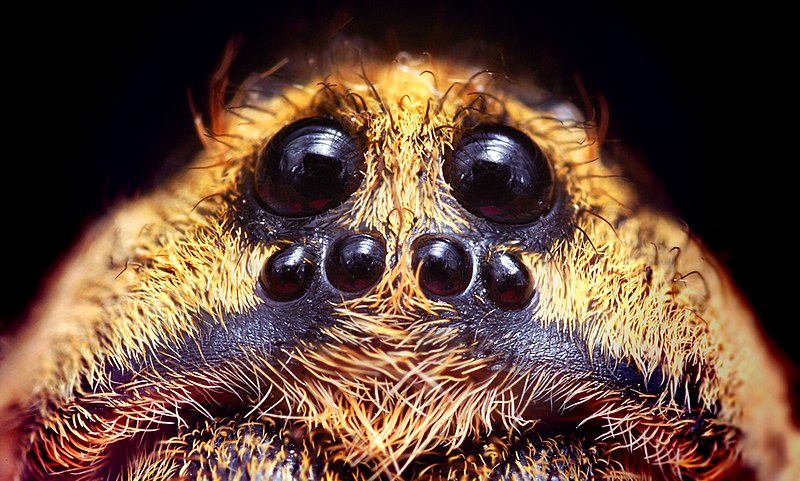
Spider Saturday is actually up on time today during our anniversary celebration! Those of you keeping up with the Facebook page may have already taken a quick look at this big local spider. This past May I was taking a walk and stumbled across this mean looking spider crawling across a path by the Johnson Art Museum at Cornell University. I happened to be carrying a capture cup with me and it just managed to fit inside after some difficult maneuvering. It did manage to escape on my while trying to preserve it and was running around my room, but I managed to recapture it without any harm done. 

This spider belongs to the family of wolf spiders: Lycosidae, and is of the genus Hogna. There are many species  in this group so without putting it under a microscope to examine its nether-regions. Wolf spiders are well identified by their characteristic wolf spider eye pattern. The mothers are also well known for carrying their newborn on their abdomen as seen in this Wikipedia photo. They generally come out to hunt at night and if you are looking for them shine a flashlight down looking for the reflections in their eyes. Don't worry, as big and bad as they look, they aren't poisonous and generally not harmful to humans. 

Wednesday, August 3, 2011

Summer Buzz - NH 303


NH 303
Dog Day Cicada
Tibicen canicularis
Category: True Bugs
Family: Cicadidae

So I was shot a question the other day over the true nature of cicadas, and thus I am presenting one from the collection to quickly clear up some misconceptions. Sitting outside in the hot summer sun, you hear the most distinguishable sound of summer a loud buzz that encompasses the whole area. This is the work of the cicadas, a bug that is famous for its moltings and life-cycle. The insects themselves generally aren't seen (except as will be noted) but once they emerge from the ground the nymphs will shed their old 'skin' and leave behind the moltings, clinging to trees for us to find. 

This is where some confusion over these critters usually comes in. For those who are unaware cicadas are well known for their odd life-cycles. After laying their eggs in twigs the larva will make their way underground where they will stay for years at a time. The famous ones are the American 13 and 17 year cycle types of the Magicicada genus. This means that the larva will stay in the ground for 13 or 17 years, then will emerge in swarms, but within two months all the of them will die only leaving behind the eggs for the next periodical cycle to begin. 

However, this particular specimen isn't one of the extremely long term species. It's a common Dog-Day Cicada of the Northeast US, and this one is just an annual cicada. So rather than waiting in the ground for 17 years, the nymphs are only buried for a year where they feed on root juices. They all don't come out at once, but are distributed throughout July and August. And because the nymphs feed on the roots of trees they are known to be a pest.

Also, you may be wondering what is the point to having a 17 year developing stage only to live 'normally' for a summer? Well it's believed that emerging in one massive brood can overwhelm predators like birds. It is also thought that having such a long and prime-numbered life cycle makes it harder for predators to keep track of. As always here is an informational page on the Periodical Cicadas for you to learn more about their life cycles and how to deal them as pests. 

Saturday, June 25, 2011

Spider Ant - NH 221

NH 221
Jumping Spider
Sarinda hentzi
Category: Arachnids
Family: Salticidae

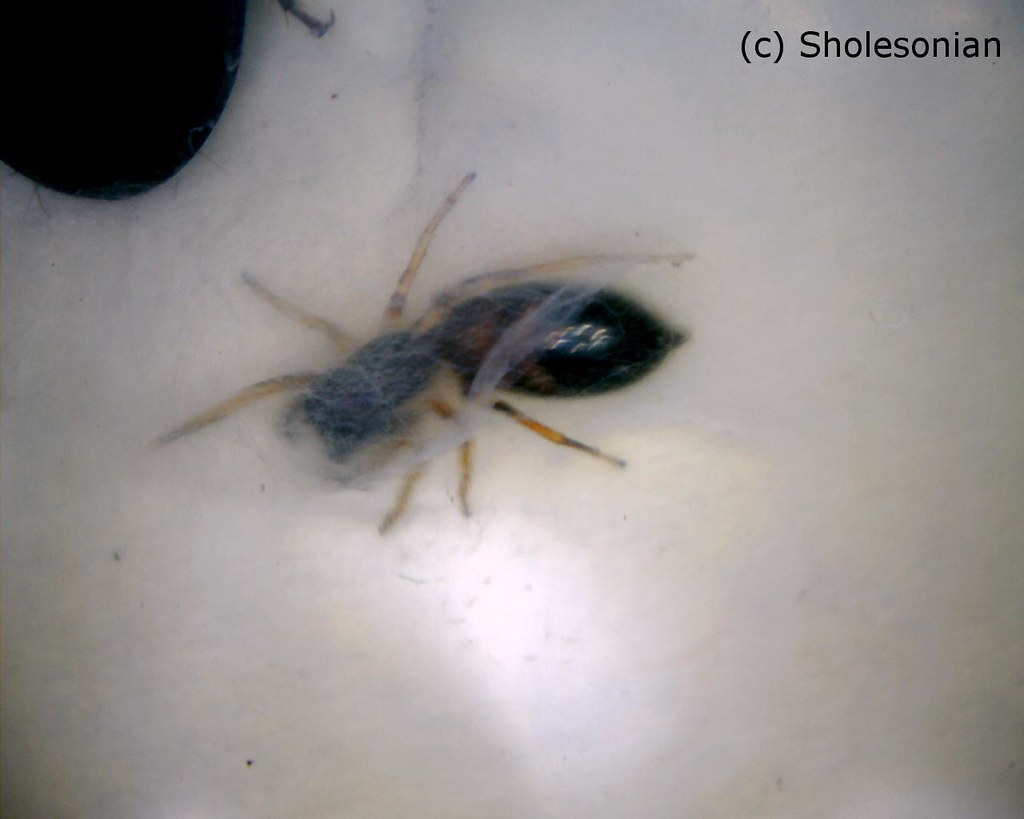
Unfortunately I had a wedding to attend to last week so there was no Spider Saturday, but we are back up today with this very cool, albeit small, addition to the arachnid collection. This particular spider was found crawling on a door in the basement of the PRI in Ithaca, New York back on June 2, 2011. At first I thought it was just another ant, but with good cause. This particular jumping spider is known as an ant-mimicing spider because not only do they look like ants but they behave in ways to get predators to back off thinking they are an ant.

You can see the two front legs in the picture (at the bottom); it will wave these front legs up and down to mimic an ant's antennae. This tactic is used to keep predators away, as many such as wasps will avoid ants due to their aggressiveness and unpredictability. This particular specimen is a female and was collected along with a ground stag beetle, and these jumping spiders will create a small web enclosure to use for protection (from this menacing beetle also in the bag) and she would also use this web for mating, resting, molting, among other things. Below you will find an image of the spider crawling into her newly made web of protection.

Saturday, June 11, 2011

Running Crab - NH 217


NH 217
Running Crab Spider
Philodromus sp.
Category: Arachnids
Family: Philodromidae

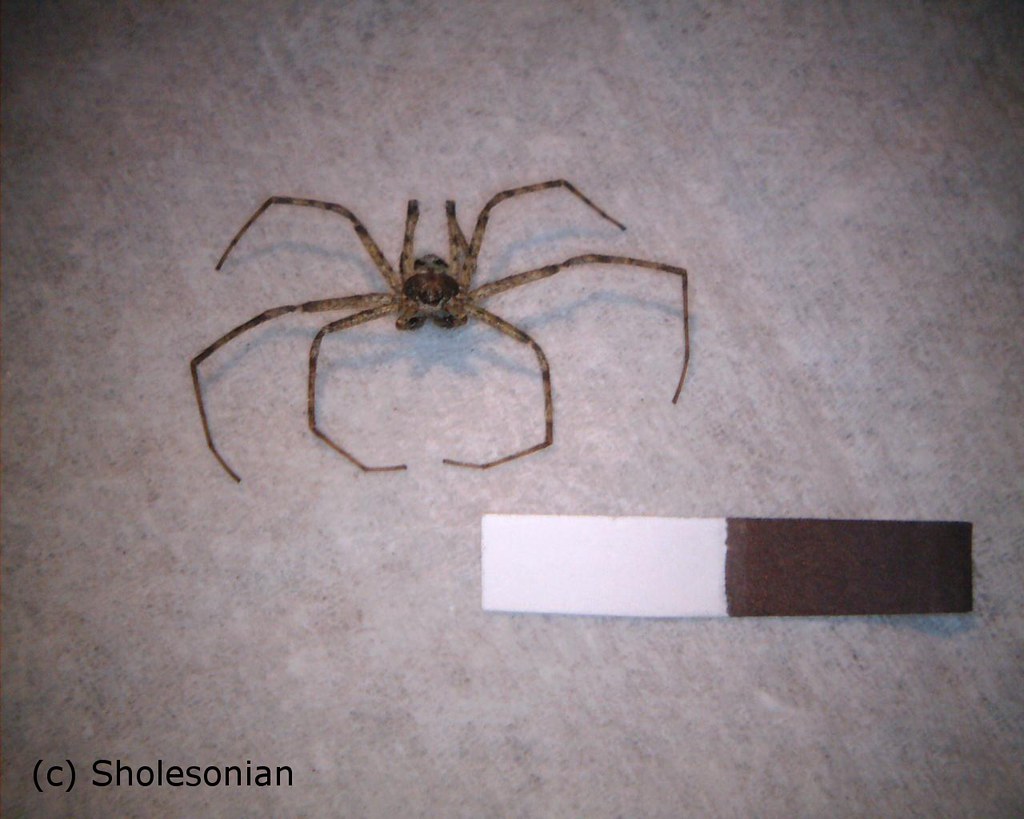
Spider Saturday is back! And to start off a summer of spiders, we have this guy who is a running crab spider of the Philodromus genus. It's a fairly large genus with hundreds of species, so we can't be positive of what species this guy is unless we took a look under the microscope. This guy was found on May 29, 2011 in Cass Park, Ithaca, New York. 

I don't have too much information about these guys at the moment, though I'll try and look up some more information next time I go to the library as there is only so much information I can dig up on the internet. These philodromid crab spiders do not have webs though some will use silk as a dragline. This particular genus is generally flattened and you can see some visual aids in the identification process of Philodromus spiders here. And as you can see from the photo these spiders tend to have few, if any, hairs/spines on their bodies (known as setae). 

Monday, June 6, 2011

Colorado in New York - NH 222


NH 222
Colorado Potato Beetle
Category: Beetles
Family: Chrysomelidae

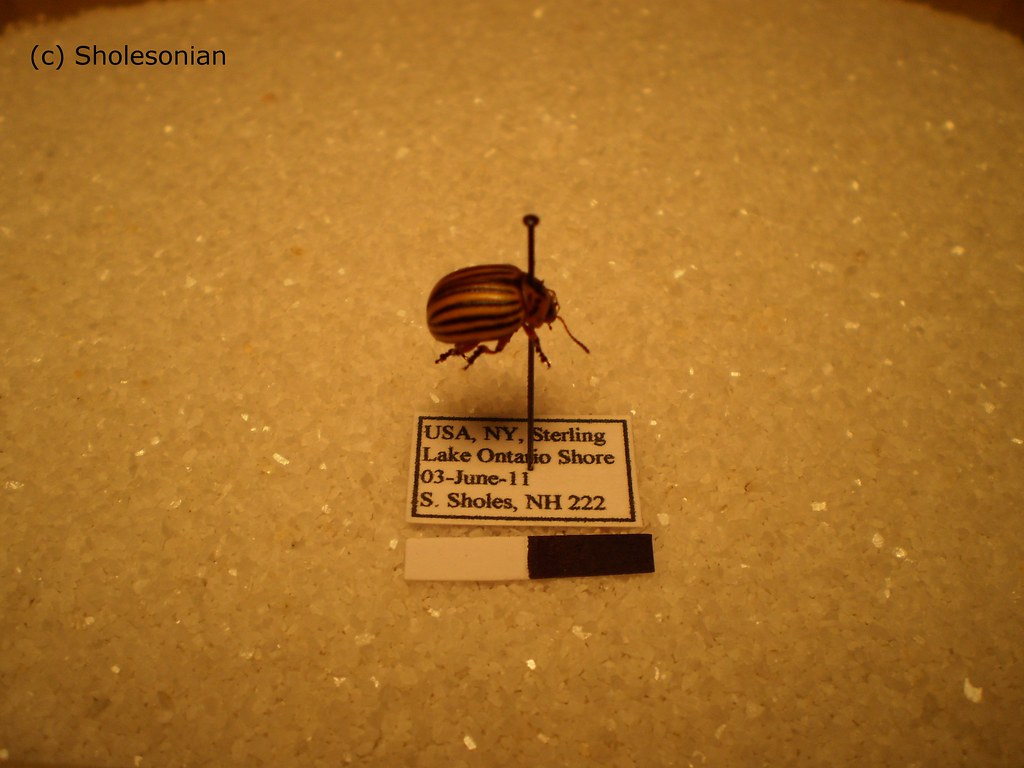
The newest insect in the Natural History Collection is this interesting beetle. Found on the rocky shore of Lake Ontario up by Sterling, New York on June 3, 2011. While you can't see it so well in the picture the beetle is an orange-yellowish color with ten black stripes running down the back. Its scientific name is Leptinotarsa decemlineata and despite its common name as the Colorado Potato Bug it is found throughout the United States and has even spread to Europe and mid-Asia. 

These little guys are a real pest. As their name implies they eat potatoes and can quickly skeletonize a plant. The real problem is controlling the population. These beetles are able to rapidly develop immunities to whatever we throw at it. Up until the 1950's they were relatively under control until they developed a resistance to DDT. Over time they have developed resistances to many of the pesticides attempted to control them and have learned to cope with other insects and predators used as sort of a live pesticide. They do have a weakness: a specific species of fungus is the scourge of the potato beetle and is the most widely used form of population control. 

These guys have an interesting history encompassing the history of the beetle and the potato. You can read up a little on it here at this Colorado Potato Beetle page. 

Wednesday, April 27, 2011

Olive Shell - NH 095


NH 095
Olive Snails
Category: Gastropods
Family: Olividae

Well after a two week hiatus, the Sholesonian is back up with a blog post. Not to worry though, as during those past two weeks I have been busy with curating the specimens in the Natural History collection as well as capturing new species to add. Today's post is brought through a small donation of nice shells from Myrtle Beach,  South Carolina. Collected in April of 2011, these two shells belong to the Olividae family and are of the Genus Oliva (species is most likely Oliva sayana). These are snail shells that are commonly referred to as 'olive shells' or just 'olives.' 

They are a predatory species of marine snail, feasting on primarily small bivalves (like clams). Known for their elongated shape, these snail shells have been used for centuries in making jewelry and have become so popular, especially among collectors, that it is now the state shell of South Carolina. Also known for burrowing, these guys can be found mainly across the coasts of the Western Atlantic. You can read up a little on the Olive Shells here but there isn't too much to go on and you may have to do some jumping around. 

Friday, April 8, 2011

NH 027 - Aphid


NH 027
Aphid
Category: True Bugs
Family: Aphididae

So, apologies for not having the new photo system up for this picture and for neglecting to post anything up in awhile. The former is because over time the insect has lost its green coloring and is now more black than it was after first being captured. This guy is actually a bug (as not all insects are bugs but all bugs are insects), and I don't actually know where it came from. Cornell University's Entomology department every year throws Insectapalooza and they happened to have an aphid exhibit. This particular guy was one of the hundreds that they have that managed to escape the net and I subsequently caught it. So I don't know if it was a local species or came from somewhere else for study here, but probably the former. 

Aphids, while they cannot jump and don't always have wings, and despite their small size are known to be quite a pest. This is because the are known to carry hundreds of different plant viruses and even though they move slowly they can cause plants to become sick. They are also known for secreting a substance called honeydew (not the fruit), which contains the excess sugars that the aphid cannot use. A variety of other animals use this substance, especially some ants and bees, to eat. Some ants will even 'milk' the honeydew from the aphids in a symbiotic relationship.

Collected: Comstock Hall, Cornell University, Ithaca, New York. October 23, 2010. 

As the aphid appears today, with scale.

Tuesday, March 22, 2011

White = Blue? - NH 084


NH 084
Sea Star
Category: Echinoderms 
Family: Ophidiasteridae

In contrast to most of the specimens that are posted where I generally know what it is but don't know the locality, this particular guy had a label as to where it originated but not a whisper as to its identification. First you should all understand that the scientific way to talk about these guys is to call them 'sea stars' and not 'starfish.' This is generally just because they are in no way related to fish other than that they are both animals, fish being (Kingdom: Animalia, Phylum: Chordata) and sea stars being (Kingdom: Animalia, Phylum: Echinodermata), i.e. humans are closer to fish than these guys (because we also have a backbone). 

So while I knew that this sea star came from the Philippines I had the hardest time trying to figure out what the classification of it was. Doing some internet searches wasn't leading me anywhere, other than it was called a White Finger Sea Star, but that's just the colloquially name and while they were sold under that name none of the retailers knew the actual name. Well with a little help, it turns out that this guy is actually a Blue Starfish (Linckia laevigata), and that's no misnomer. Turns out that these sea stars are a bit thicker in the 'arms' and actually blue but are dried out and bleached in the sun. 

They're a fairly common for collecting both dead and alive (for salt-water aquariums). I'll talk more about sea stars later with another asteroid post, but for now you can learn more about Blue Starfish here or if you're interested in raising Blue Sea Stars here. 

Friday, March 11, 2011

Mantis Mayhem - NH 001


NH 001
Praying Mantis
Category: Mantids/Phasmids
Family: Mantidae

And after a week long break from posting, the Sholesonian is back up with one of the very first insect specimens collected. This praying mantis, formally known as the European Mantis (Mantis religiosa) is very common across North-Eastern United States. Originating from Europe and North Africa it was introduced to the United States back in 1899 on a shipment of plants and has since exploded in population, so much so that it is now the state insect of Connecticut. Also, I'm sure you're all familiar that these guys are known as praying mantids due to their 'praying' form with their forelegs. 

This particular guy was found trapped in a window at Cornell University, Ithaca, New York back in late August 2010 where he eventually perished due to natural causes. He (or she I'm not familiar with entomology enough to tell the difference) was subsequently vialed. You may note that in the vial the lower portion (on the left) is a bit indented which is where it was caught in the window and was bruised along with its left antenna being broken due to it drying out on the window before placing it into the alcohol. I apologize for the poor lighting but I was having difficulty with keep the glare off such a large vial and still being able to see all the distinctive features. All in all it is one of my favorite specimens in the Natural History Collection and you can read up on some more interesting facts at this Praying Mantis info site. 

UPDATE: I forgot to mention that these guys are also known for their 'sexual cannibalism' where the female will eat the male after or during mating. It turns out that this is controversial because as it happens frequently in a laboratory setting it is rarely seen in the field. Also, I do believe that this specimen is female as the males are usually more brown and smaller in size. 

Tuesday, March 1, 2011

True to Their Name - NH 075

NH 075
Box Elder Bugs
Category: True Bugs
Family: Rhopaliae
Details: 3 specimens

Originally these three guys each had their own Sholesonian ID number, but seeing as they are all from the exact same location and of the same species it is of the best interest to place them all under the same ID. These guys are known as Box Elder (or rather Boxelder) Bugs and their species name is Boisea trivittata. They are also known as the Zug or Maple Bug. What is funny is that they all were found between two pieces of cardboard boxes along with a ton more of them. I grabbed these three (which weren't squished) on November 15, 2010. Their location is a bit more cryptic; they were collected at the Ithaca Hospital in Ithaca, NY however they came off of a U-Haul truck that was moving equipment from another locale on the other side of Ithaca.

As you can see from the photograph, the Boxelder bugs are most recognizable by the red striped patterns they have. They feed almost exclusively on maple trees (the state tree of NY). While sometimes referred to as stinkbugs they do not actually emit a foul smelling secretion. Instead they emit some foul-tasting secretions to keep predators away (which also makes a mess when they are squished as seen from the others that were clustered with these three). They do hibernate over the winter (hence the large aggregation in the cardboard boxes) and are not agricultural problems but they can be a nuisance when they form such congregations and may bother some people.

UPDATE: Added a cool closeup of one of the bugs below. And if you want to learn more about them check Wikipedia or this Boxelder Bug informational site.

Saturday, February 26, 2011

Black Widow - NH 068

NH 068
Black Widow
Category: Arachnids
Family: Theridiidae

So after a a bit of a large break in the series Spider Saturday is back. This is a bit temporary at the moment as I still need to identify some of my spiders before I post them up here and have to wait until summer when I can capture some more (with a bit more diversity as well). But this is a pretty exciting addition with a bit of an interesting back-story. Also, you should note that I have come up with a new photographing structure that I will start taking up for smaller specimens. I hope it looks a bit more professional but as you can see it also includes a scale (per complaints). This scale in the bottom left has a white block and a black block each is 1cm long.

Anyway, the specimen if you haven't figured it out by now is a vial that contains quite a few baby black widow spiders. Latrodectus mactans to be exact. It's a interesting story as to its come-abouts. Over the summer my friend was collecting spiders, and without here knowing her sister placed an eggsac into one of the empty vials. Later, my friend showed us the vial which had the hatched eggsac and hundreds of baby spiders, but we didn't know what they were. Afterwards, my friend left the vial outside to let the spiders go, then we all found out that the eggsac was actually from a black widow. Don't worry though as the black widows couldn't survive in the chilly climate so no harm. In the end she thankfully donated the vial with some remaining spiders in it to me, and you should be able to clearly see one largish spider in the middle and the eggsac to the right, along with some fine web structure. The eggsac was collected in Matthews, North Carolina, USA in August of 2010.

I'm sure we all have heard some facts about black widows. In this particular species the females do on occasion eat the males and both sexes are venomous and can be fatal (the males however generally don't bite as their chelicerae (mouthparts) are too small). They do have the distinctive red hourglass pattern on their abdomens. Their diet consists mainly of insects and are occasionally preyed on my wasps, mantids, and centipedes. While their venom is extremely potent it is extracted in such small volumes that it generally doesn't lead to death but can still be quite harmful.

I've also included a very cool photograph of what the vial looked like after the eggsac hatched and all the spiders where still inside, rather than just the few that remain. And if you want to look up more information check out this black widow page. Enjoy!

Sunday, January 30, 2011

Sweet Honey - NH 024

NH 024
Honey Bee
Category: Bees and Kin
Family: Apidae

I again apologize for the lack of updates but it's been busy. Seeing as today is Saturday and I haven't adhered to Spider Saturday in awhile I thought I should dig up a spider, however I'm still a bit wary on the identification of the remaining few specimens and I thus hesitate to post them yet. Hopefully over the summer I will be collecting many more specimens, but since I'm not posting a spider I'm going to just go with something from Natural History.

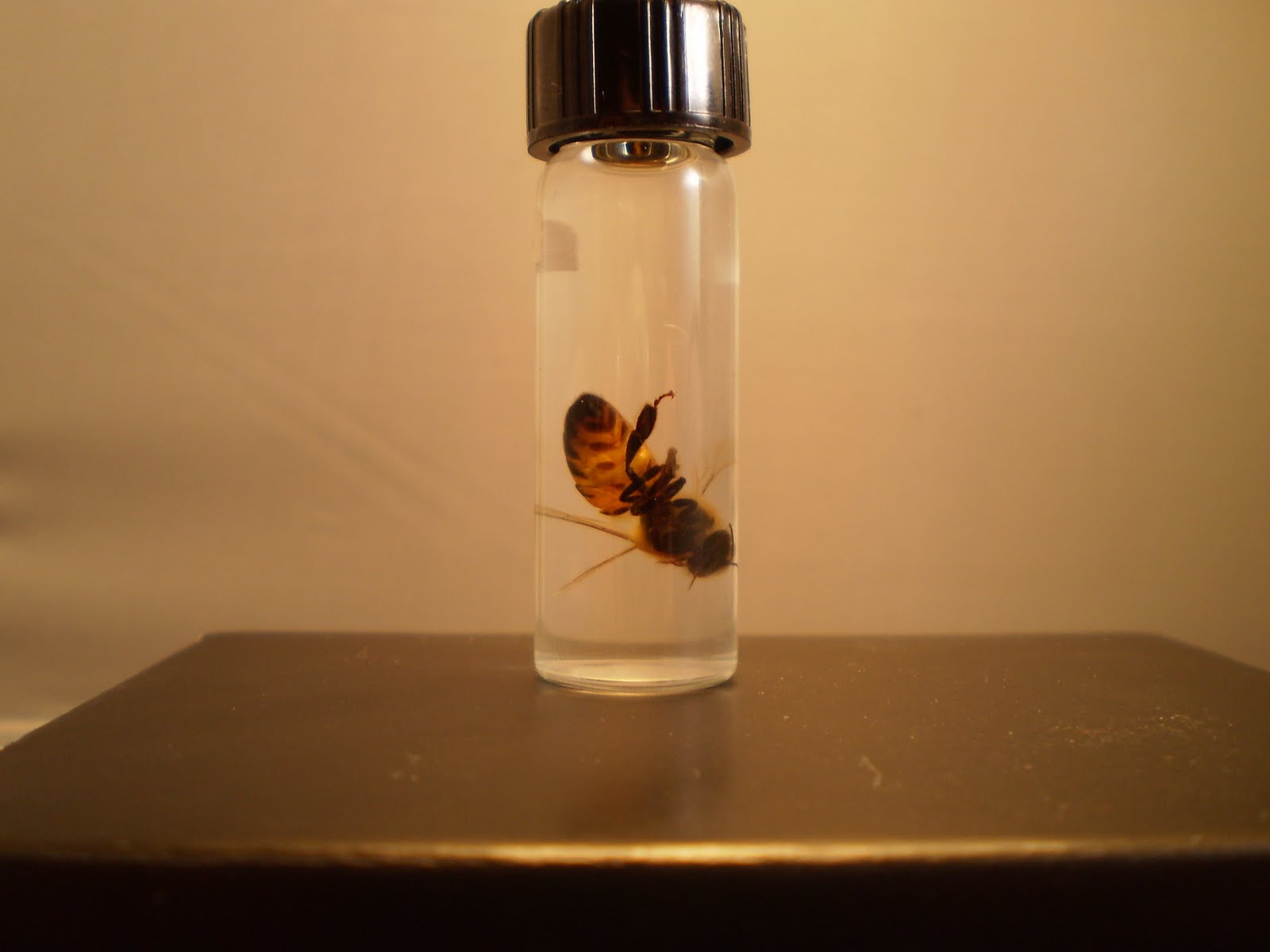
Now, I'm not positive on the identification of this specimen but judging from information obtained from the InsectIdentification website's page on Honey Bees I'm going to temporarily go with that. Now the picture on the site shows a yellow-colored head, but from the information provided this would be a worker bee with it's nearly all black head. I'm sure it's common knowledge that these guys go around pollinating flowers and have extensive colonies, so I'm not going to go into too much detail on the lives of worker bees.

This guy, which I'm going out on a limb and declaring him Apis mellifera, was collected in Ithaca, New York, USA sometime in early September 2011. I unfortunately am lacking more details on this specimen as the record I keep is incomplete on specimens with ID numbers less than 26. But anyway it's a unique pose he has in the vial, so enjoy.

Saturday, January 8, 2011

It's A Leaf! - NH 098

NH 098
Walking Leaf
Category: Phasmids
Family: Phylliidae

Sorry guys, but I'm not going to be able to post a spider today and there hasn't been any the past few weeks due to the holidays. But to make up for it I'm posting the newest addition to the Sholesonian which I actually just got today. Now it's not a spider, rather it belongs to the order Phasmatodea which also includes the very cool walking sticks. This particular species is Phyllium pulchrifolium (which if I understand my Latin the species name means beautiful foliage) though according to Wikipedia the species is also known as Phyllium bioculatum, but for now I'm sticking with the P. pulchrifolium classification.

This one, like my giant orb weaver, comes from Indonesia - specifically Banten, West Java and was collected last year in January of 2010. Now apparently these guys do have wings, though I guess that shouldn't come as much of a surprise. They can also be different colors depending on their environment, so a community that lives on brown-leaves trees they all might be brownish whereas this particular specimen obviously lived on green-leaved trees; however do not take this as they can change colors. You can tell this is a female specimen because of the short antennae, whereas males have much longer ones.

These guys typically only live for about four to seven months. And as ironic as it may be, they camouflage themselves to protect themselves from predators but they eat leaves themselves. Their reproduction methods are also interesting. The females can lay eggs with or without male fertilization. If laid without a male all the offspring will be female whereas it requires a male to fertilize the eggs for any males to be born. Check out these walking leaves in more detail. And to boot, I've taken a couple of cool highly magnified photos of the head and 'spine.'


Thursday, December 23, 2010

Roly-Poly Isopod - NH 019

NH 019
Woodlice
Category: Crusteceans
Family: Armadillidiidae

So we all know what these guys are, well I'm sure you all think you know what these guys are. They are known by a variety of names including pill bugs, roly polies, potato bugs, and many others but less commonly by their actual name. They are woodlice. However despite their names they are not actually bugs, nor insects for that matter - they are crustaceans and thus more closely related to crabs than millipedes. While I can't say for certain it seems as though that these two guys belong to the genus Armadillidium in the family Armadillidiidae. Just skimming the internet it's likely that they are of the species A. vulgare which is the common woodlouse originating in Europe but has since spread to the Americas.

I collected these guys under a stone slab outside of Baker Tower, Cornell University, Ithaca, NY in early September 2010. And while I have given you a species name that is only temporary as I am completely unsure about that, however I'm fairly certain of the family. If you are looking for some more information about them you can find this Pill Bug science page enlightening about their habitat, life cycles, and reproduction or you can check out the A. vulgare page for more information about that particular species.

Saturday, December 18, 2010

Thin and Dusty - NH 012

NH 012
Long-Bodied Cellar Spider
Category: Arachnids
Family: Pholcidae

Sorry for the lack of updates over the past week, but it was finals week so I was busy studying. However the year is over and for the next month you should all be expecting lots of new updates. And don't worry, I haven't forgotten Spider Saturday. Speaking of Spider Saturday, if you haven't already check out last week's specimen which was the giant Golden Orb Weaver. This week, however, is something a bit smaller and a bit more fragile. I posted a similar specimen awhile back, the Cellar Spider, and this particular spider is in the same family (if not the same species).

This particular guy is also a Fulcid (the cellar spiders), and was found at Cornell University sometime in early September 2010. A little bit of quick identification by a friend has this guy classified as a Long-Bodied Cellar Spider (Pholcus phalangiodes). However, if you note from the previous cellar spider's post I had temporarily classified him as a Pholcus phalangiodes and unfortunately seeing as I'm not actually an expert on arachnid identification I'm just going to go out on a limb and say that the previous post (NH 021) was incorrectly identified (at least to the species level), though this is just my personal judgement. They are at least in the end both of the family Pholcidae.

Saturday, December 11, 2010

Giant of a Spider - NH 099

NH 099
Giant Golden Orb Weaver
Category: Arachnids
Family: Nephilidae

Don't worry I haven't forgotten about Spider Saturday, but in celebration of the Sholesonian's 'Birthday' yesterday I'm giving you guys the spider of the Natural History Collection. This behemoth of a spider is over eight inches long and I have actually included a standard US quarter for scale. This particular guy comes from Jember, East Java, Indonesia so if you aren't particularly fond of large orb weaving spiders you might want to cancel next year's vacation plans to Indonesia. But really these Giant Golden Orb Weavers (Nephila maculata) are essentially completely harmless to humans. They do have some venom but it isn't deadly to humans.

Being the largest orb-weaving spider, these guys can spin webs that are up to 6 meters tall and two meters wide (for scale your refrigerator is about 2 meters tall). They generally eat large insects that may fall into their trap, but they themselves often fall prey to birds and natives. This specimen is clearly a female as indicated by its enormous size. The males of the species can be over a hundred times smaller and are sometimes eaten by their mate. Thus the male will have to sneak up on the female while she is eating in order to mate. Their webs are incredibly strong and have been used in fishing nets for centuries, the stuff is tougher than Kevlar.

So hopefully you enjoy this monstrous beast, and if you would like some more information on these giant spiders just check this link. Also if you are interested in getting one of these guys email the museum and I can direct you where you can get one without having to travel to Indonesia. Also, it may be interesting to note that the Natural History Museum of Los Angeles has a spider pavilion which does have Nephila maculata among other large arachnids, where you can walk around check them out.

Also, I will work on taking a better photograph. There is some nice intricate golden designs on the body that you might not be able to see.

Saturday, December 4, 2010

Tiny Hopper - NH 015

NH 015
Jumping Spider
Category: Arachnids
Family: Salticidae

I was going to post up a my really good spider up today but haven't had time to photograph it right, but I haven't forgotten Spider Saturday so I'm presenting the smallest vial in the collection today. I don't have too much information on this particular specimen. At the moment I only have the family name (Salticidae), which is the grouping for jumping spiders. More unfortunate news is that this guy was collected before I was keeping good tabs on collection dates and localities, thus there is very little exact information on it.

Jumping spiders are active hunters. So instead of building a web and waiting for prey to get caught, they go out and will scour for food. They can jump several times their body length (forwards and backwards) and while they don't have webs they still do have silk that they anchor to the ground before they jump so in the event they end up falling a great height they will be able to climb back up to live another day. What's also interesting about this family is that they are very curious creatures, especially when it comes to humans.

This jumping spider was found above the mirror in a bathroom in Baker Tower, Cornell University, Ithaca, New York, USA sometime in early-mid September 2010.

Wednesday, December 1, 2010

Alien Invader - NH 026

NH 026
Marmorated Stinkbug
Category: True Bugs
Family: Pentatomidae

Today's insect comes from the Pentatomidae family, and you may know it by its common name: the stinkbug. This particular specimen is a Brown Marmorated Stinkbug and was collected inside Baker Tower, Cornell University, Ithaca, New York, USA on the 15th of October 2010 around 6:00pm. The Marmorated Stinkbug (Halyomorpha halys), has a brownish camouflage-like color but when placed into the alcohol its wings opened up and the liquid diluted the color a bit to reveal some yellow striped patterns underneath.

What's so interesting about this particular exhibit is that as it turns out this species of stinkbug is actually a huge pest in the Eastern United States. Originally from Asia, they eventually made it to Pennsylvania and have spread since then. They infiltrate houses (and most people don't want stink bugs in their homes) as well as eat and destroy crops. Since their discovery in Allentown, Pennsylvania in 1998 they have spread to 15 states and counting including New York. This China native has become a serious invasive species creating many problems here in the Northeast. However, there is no way to control this species at present.

And have a happy first of the month!

Tuesday, November 23, 2010

Humped Cricket - NH 067

NH 067
Camel Cricket
Category: Grasshoppers and Kin
Family: Rhaphidorphoridae

So, glancing at the Collections of Natural History page I realized that I haven't really posted anything up from other than spiders and a few other insects. That being said I am now going to present the first from the Grasshoppers and Kin group: a Camel Cricket. Now when I first collected this guy he was temporarily identified as a mole cricket, I think someone may have told me that's what they looked like. But with a bit of research it turns out that it is actually a camel cricket-easily identified by its humped back. It was living under a rock in the Cornell Arboretum, Cornell University, Ithaca, New York, USA and was found on October 26, 2010 at 5:30pm.

There isn't much else to say about them. It seems that they have a tendency to accidentally find themselves indoors and will make a new home in a basement or other similar dark and damp place. They are pests only in that they come into houses and are unwanted but other than that they don't really cause any harm. I am going to temporarily classify him as a Spotted Camel Cricket (Ceuthophilus maculatus), but as always this is only for the time being unless an expert can help me out on this front. But if you want to learn more about the Rhaphidophoridae family you can check out the link.