Showing posts with label Spider Saturday. Show all posts

Saturday, October 15, 2011

Spider Wolf - NH 155


NH 155
Wolf Spider
Hogna sp.
Category: Arachnids
Family: Lycosidae

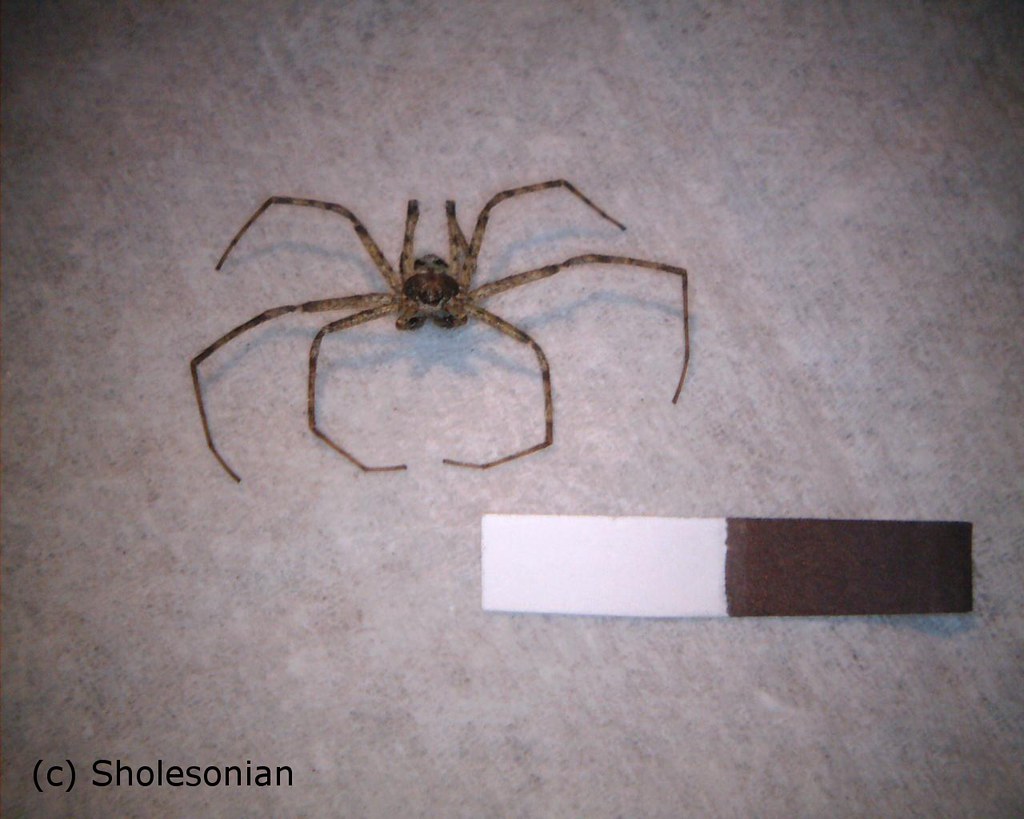
Spider Saturday is actually up on time today during our anniversary celebration! Those of you keeping up with the Facebook page may have already taken a quick look at this big local spider. This past May I was taking a walk and stumbled across this mean looking spider crawling across a path by the Johnson Art Museum at Cornell University. I happened to be carrying a capture cup with me and it just managed to fit inside after some difficult maneuvering. It did manage to escape on my while trying to preserve it and was running around my room, but I managed to recapture it without any harm done. 

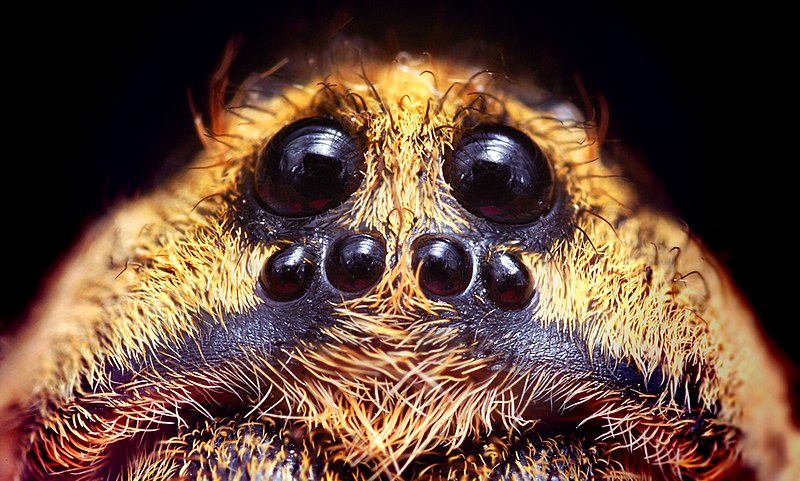
This spider belongs to the family of wolf spiders: Lycosidae, and is of the genus Hogna. There are many species  in this group so without putting it under a microscope to examine its nether-regions. Wolf spiders are well identified by their characteristic wolf spider eye pattern. The mothers are also well known for carrying their newborn on their abdomen as seen in this Wikipedia photo. They generally come out to hunt at night and if you are looking for them shine a flashlight down looking for the reflections in their eyes. Don't worry, as big and bad as they look, they aren't poisonous and generally not harmful to humans. 

Saturday, June 25, 2011

Spider Ant - NH 221

NH 221
Jumping Spider
Sarinda hentzi
Category: Arachnids
Family: Salticidae

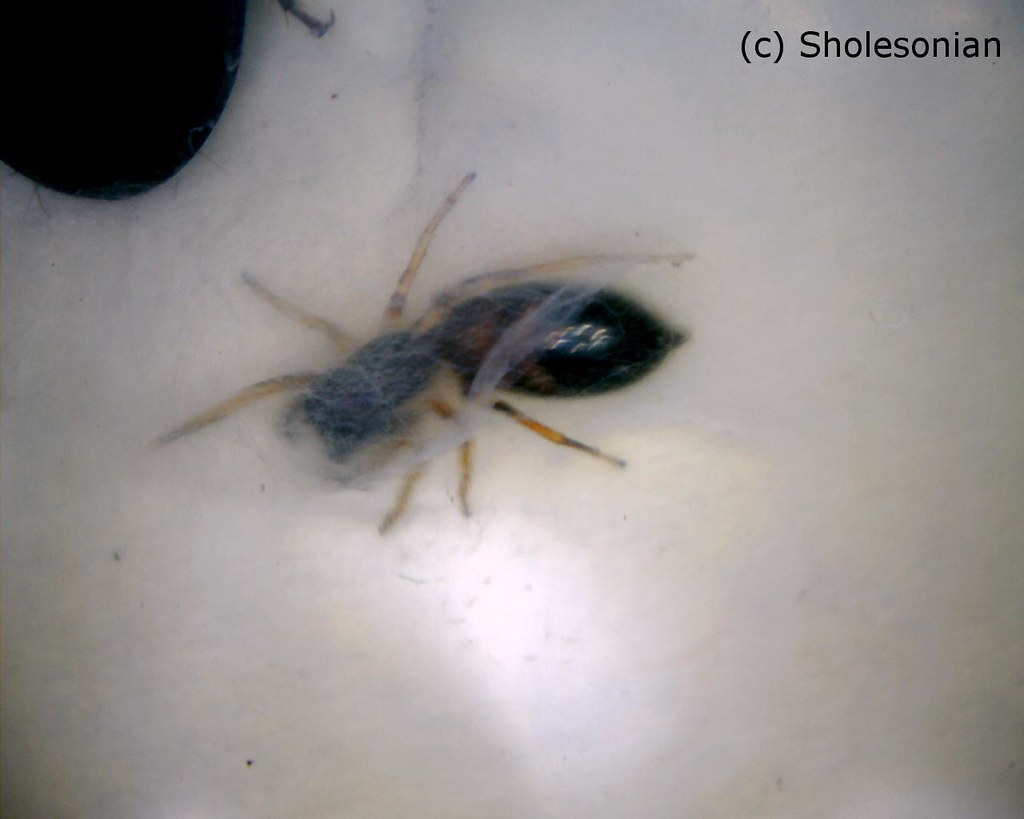
Unfortunately I had a wedding to attend to last week so there was no Spider Saturday, but we are back up today with this very cool, albeit small, addition to the arachnid collection. This particular spider was found crawling on a door in the basement of the PRI in Ithaca, New York back on June 2, 2011. At first I thought it was just another ant, but with good cause. This particular jumping spider is known as an ant-mimicing spider because not only do they look like ants but they behave in ways to get predators to back off thinking they are an ant.

You can see the two front legs in the picture (at the bottom); it will wave these front legs up and down to mimic an ant's antennae. This tactic is used to keep predators away, as many such as wasps will avoid ants due to their aggressiveness and unpredictability. This particular specimen is a female and was collected along with a ground stag beetle, and these jumping spiders will create a small web enclosure to use for protection (from this menacing beetle also in the bag) and she would also use this web for mating, resting, molting, among other things. Below you will find an image of the spider crawling into her newly made web of protection.

Saturday, June 11, 2011

Running Crab - NH 217


NH 217
Running Crab Spider
Philodromus sp.
Category: Arachnids
Family: Philodromidae

Spider Saturday is back! And to start off a summer of spiders, we have this guy who is a running crab spider of the Philodromus genus. It's a fairly large genus with hundreds of species, so we can't be positive of what species this guy is unless we took a look under the microscope. This guy was found on May 29, 2011 in Cass Park, Ithaca, New York. 

I don't have too much information about these guys at the moment, though I'll try and look up some more information next time I go to the library as there is only so much information I can dig up on the internet. These philodromid crab spiders do not have webs though some will use silk as a dragline. This particular genus is generally flattened and you can see some visual aids in the identification process of Philodromus spiders here. And as you can see from the photo these spiders tend to have few, if any, hairs/spines on their bodies (known as setae). 

Saturday, February 26, 2011

Black Widow - NH 068

NH 068
Black Widow
Category: Arachnids
Family: Theridiidae

So after a a bit of a large break in the series Spider Saturday is back. This is a bit temporary at the moment as I still need to identify some of my spiders before I post them up here and have to wait until summer when I can capture some more (with a bit more diversity as well). But this is a pretty exciting addition with a bit of an interesting back-story. Also, you should note that I have come up with a new photographing structure that I will start taking up for smaller specimens. I hope it looks a bit more professional but as you can see it also includes a scale (per complaints). This scale in the bottom left has a white block and a black block each is 1cm long.

Anyway, the specimen if you haven't figured it out by now is a vial that contains quite a few baby black widow spiders. Latrodectus mactans to be exact. It's a interesting story as to its come-abouts. Over the summer my friend was collecting spiders, and without here knowing her sister placed an eggsac into one of the empty vials. Later, my friend showed us the vial which had the hatched eggsac and hundreds of baby spiders, but we didn't know what they were. Afterwards, my friend left the vial outside to let the spiders go, then we all found out that the eggsac was actually from a black widow. Don't worry though as the black widows couldn't survive in the chilly climate so no harm. In the end she thankfully donated the vial with some remaining spiders in it to me, and you should be able to clearly see one largish spider in the middle and the eggsac to the right, along with some fine web structure. The eggsac was collected in Matthews, North Carolina, USA in August of 2010.

I'm sure we all have heard some facts about black widows. In this particular species the females do on occasion eat the males and both sexes are venomous and can be fatal (the males however generally don't bite as their chelicerae (mouthparts) are too small). They do have the distinctive red hourglass pattern on their abdomens. Their diet consists mainly of insects and are occasionally preyed on my wasps, mantids, and centipedes. While their venom is extremely potent it is extracted in such small volumes that it generally doesn't lead to death but can still be quite harmful.

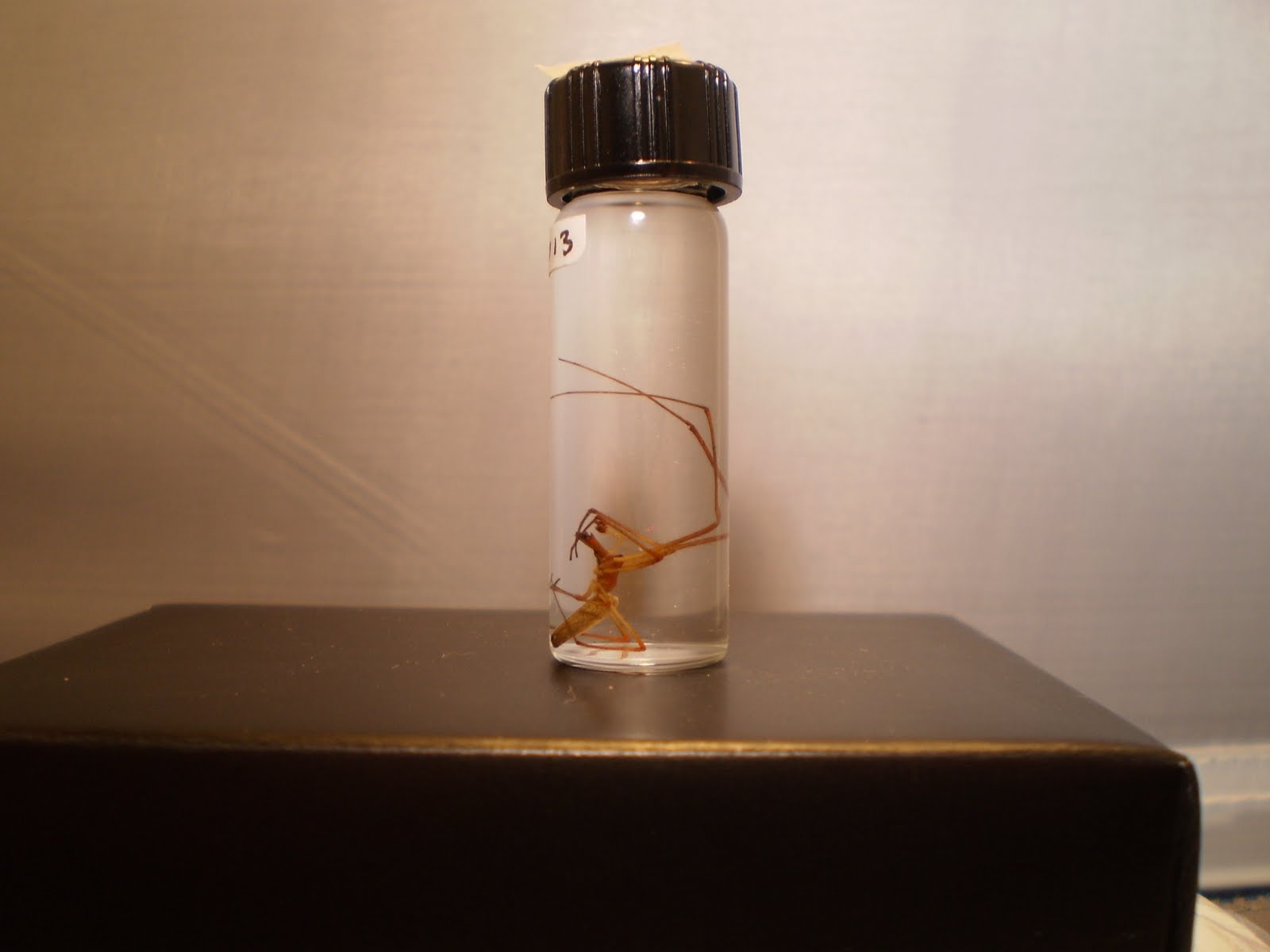
I've also included a very cool photograph of what the vial looked like after the eggsac hatched and all the spiders where still inside, rather than just the few that remain. And if you want to look up more information check out this black widow page. Enjoy!

Saturday, December 18, 2010

Thin and Dusty - NH 012

NH 012
Long-Bodied Cellar Spider
Category: Arachnids
Family: Pholcidae

Sorry for the lack of updates over the past week, but it was finals week so I was busy studying. However the year is over and for the next month you should all be expecting lots of new updates. And don't worry, I haven't forgotten Spider Saturday. Speaking of Spider Saturday, if you haven't already check out last week's specimen which was the giant Golden Orb Weaver. This week, however, is something a bit smaller and a bit more fragile. I posted a similar specimen awhile back, the Cellar Spider, and this particular spider is in the same family (if not the same species).

This particular guy is also a Fulcid (the cellar spiders), and was found at Cornell University sometime in early September 2010. A little bit of quick identification by a friend has this guy classified as a Long-Bodied Cellar Spider (Pholcus phalangiodes). However, if you note from the previous cellar spider's post I had temporarily classified him as a Pholcus phalangiodes and unfortunately seeing as I'm not actually an expert on arachnid identification I'm just going to go out on a limb and say that the previous post (NH 021) was incorrectly identified (at least to the species level), though this is just my personal judgement. They are at least in the end both of the family Pholcidae.

Saturday, December 11, 2010

Giant of a Spider - NH 099

NH 099
Giant Golden Orb Weaver
Category: Arachnids
Family: Nephilidae

Don't worry I haven't forgotten about Spider Saturday, but in celebration of the Sholesonian's 'Birthday' yesterday I'm giving you guys the spider of the Natural History Collection. This behemoth of a spider is over eight inches long and I have actually included a standard US quarter for scale. This particular guy comes from Jember, East Java, Indonesia so if you aren't particularly fond of large orb weaving spiders you might want to cancel next year's vacation plans to Indonesia. But really these Giant Golden Orb Weavers (Nephila maculata) are essentially completely harmless to humans. They do have some venom but it isn't deadly to humans.

Being the largest orb-weaving spider, these guys can spin webs that are up to 6 meters tall and two meters wide (for scale your refrigerator is about 2 meters tall). They generally eat large insects that may fall into their trap, but they themselves often fall prey to birds and natives. This specimen is clearly a female as indicated by its enormous size. The males of the species can be over a hundred times smaller and are sometimes eaten by their mate. Thus the male will have to sneak up on the female while she is eating in order to mate. Their webs are incredibly strong and have been used in fishing nets for centuries, the stuff is tougher than Kevlar.

So hopefully you enjoy this monstrous beast, and if you would like some more information on these giant spiders just check this link. Also if you are interested in getting one of these guys email the museum and I can direct you where you can get one without having to travel to Indonesia. Also, it may be interesting to note that the Natural History Museum of Los Angeles has a spider pavilion which does have Nephila maculata among other large arachnids, where you can walk around check them out.

Also, I will work on taking a better photograph. There is some nice intricate golden designs on the body that you might not be able to see.

Saturday, December 4, 2010

Tiny Hopper - NH 015

NH 015
Jumping Spider
Category: Arachnids
Family: Salticidae

I was going to post up a my really good spider up today but haven't had time to photograph it right, but I haven't forgotten Spider Saturday so I'm presenting the smallest vial in the collection today. I don't have too much information on this particular specimen. At the moment I only have the family name (Salticidae), which is the grouping for jumping spiders. More unfortunate news is that this guy was collected before I was keeping good tabs on collection dates and localities, thus there is very little exact information on it.

Jumping spiders are active hunters. So instead of building a web and waiting for prey to get caught, they go out and will scour for food. They can jump several times their body length (forwards and backwards) and while they don't have webs they still do have silk that they anchor to the ground before they jump so in the event they end up falling a great height they will be able to climb back up to live another day. What's also interesting about this family is that they are very curious creatures, especially when it comes to humans.

This jumping spider was found above the mirror in a bathroom in Baker Tower, Cornell University, Ithaca, New York, USA sometime in early-mid September 2010.

Saturday, November 20, 2010

Long Jawed - NH 013

NH 013
Long Jawed Orb Weaver
Category: Arachnids
Family: Tetragnathae

It's Spider Saturday once again, and while I promised some of you that I would be posting the newest arachnid addition to the Sholesonian, the permanent display has yet to be finished so you'll have to wait a little bit longer (maybe next week but I can't be sure over the holiday weekend). So I have decided to post up one of my favorite spiders from the vault. This guy was collected on the Thurston Avenue Bridge, Cornell University, Ithaca, New York, USA sometime in September after dusk. The bridge is literally crawling with thousands of these guys and other spiders and they are most prominently seen at nightfall.

What's cool about these Long-Jawed Orb Weavers is that you can actually see that their jaws are longer than other common orb weavers, but also they have a longer pair of legs in the front. You can clearly see both distinct characteristics in the photograph, and I think that it makes a great new addition to the museum. It isn't poisonous but does have a certain unnerving quality to it that makes it one of the finer pieces. It belongs to the family Tetragnathae, and I'm pretty sure I've broken it down into the Tetragnatha genus. Other than that I don't think I can get species at the moment, a lot of them look similar.

Saturday, November 13, 2010

Acting Crabby - NH 020

NH 020
Crab Spider
Category: Arachnids
Family: Thomisidae

I apologize for not posting anything in awhile, I've been a little busy lately. But it doesn't matter because it's Spider Saturday! Now, since I've been busy I don't have too much information on this guy, only his family which is Thomisiade. What I like about these spiders is that they differ from the usual color scheme and they have the distinctive angled front legs which look look oddly enough like their namesake: crab spiders.

The unfortunate thing about this particular guy is that I don't have complete labeling data for him. I know that he was captured in early September, but locality wise I think it may have been at Baker Tower, Cornell, Ithaca; but I'm not positive about that. It is kind of odd though that I found him indoors because crab spiders like to live on flowers (hence the yellowish coloring) and ambush their prey rather than building a web and waiting. Also another interesting fact about them is that they continue to resemble crabs in that they are able to walk sideways. Now running through the pages associated with the crab spider Wikipedia page, I think that this guy (or girl for that matter) is in the genus Misumena though I am entirely unsure about that - those in this genus are the flower crab spiders. And for those who have always wanted pictures with some sort of scale, here's one finally.

Saturday, November 6, 2010

Scary Cellars - NH 021

NH 021
Cellar Spider
Category: Arachnids
Family: Pholcidae

Sorry for the lack of updates the past few days, I've been both busy and tired and never got around to it. But I would not forget to give you guys Spider Saturday! So here is the next arachnid on the circuit. This guy is known as a cellar spider and while I'm most definitely not positive about the exact classification, I'm going to go out on a limb and say Pholcus phalangioides, though if you know your stuff and think otherwise please let me know. But I do know that it does belong to the family Pholcidae.

He (and this time I am thinking that it actually is a male due to its smaller size) was found funny enough not exactly in a cellar but the lowest level of the building nonetheless: first floor of Baker Tower. If you guys remember when I posted up my Harvestman a few weeks back I gave you the rundown on daddy longlegs. And while I consider the harvestmen to be the true daddy longlegs I guess there is some regional differences and these guys are often called by the same term. I really don't see it that much. Yeah they have long legs but they look very different. Not much more to say on them really, they do spin webs and this guy was captured in early-mid September 2010.

You check more about this species of cellar spider here.

Saturday, October 30, 2010

Funnel Web Weaver - NH 007

NH 007
Grass Spider
Category: Arachnids
Family: Agelenidae

It's Saturday, which means only one thing, that it's Spider Saturday! Today's spider is actually the first spider from outside my building I caught and vialed for the collection. This spider is a very common grass spider here in Ithaca. This guy belongs to the genus Agelenopsis and is probably a male. He was found behind Warren Hall , Cornell University, Ithaca, New York, USA and collected on September 18th, 2010. These guys build funnel webs to live and catch their prey (though their webs aren't sticky like the stereotypical spider web, but they are quite fast and agile).

This guy's web was made in a Hosta plant. If you haven't noticed from the picture, he is actually missing his two front right legs. I have no idea where they are but he was living fine in his web without them. And you may be wondering what that white stuff is in there. Well unlike a previous specimen where it was guts, this is just some of his web that caught in his legs and I couldn't get it off before I vialed him.

Saturday, October 23, 2010

Epic Battle - NH 003

NH 003
Banded Garden Spider
Category: Arachnids
Family: Araneidae

So, it's Saturday and I think I'll continue on with Spider Saturday here at the Sholesonian. Today is a very interesting piece that I personally collected, interesting in both how big it is and the story about how I captured it. First off, I can tell you that this is a Banded Garden Spider (Argiope trifasciata) after I mis-identified it as a Common Black and Yellow Garden Spider (thanks Kayla). Second, I should tell you how I go about collecting my spider collections. I use those plastic cups with lids that normally are used for taking ketchup and other condiments for on the go, and I just scoop them up when I find them.

Now, for this particular guy I was walking from one class to another and spotted him on a bush next to Goldwin-Smith, Cornell University, Ithaca in mid-September. He was so big and different from the other spiders I have that I had to catch him, and luckily I had an empty cup with me. The unfortunate thing was that he (and I'm only using he because I actually don't know the gender) had just managed to capture lunch in his web, a common bee (NH 024) and had just started to envelop it. But I had to get to my next class so I just scooped them both up in the cup and continued on to class. The thing was that the bee would not stop buzzing and they were in some sort of epic battle in my pocket. It was amusing as when the whole room was silent all you could hear were the two of them 'fighting.' Anyway, that's the reason why he has lost two legs. And that white stuff that is in the vial is I guess 'guts.'

So anyway, hope you enjoy this awesome addition to the collection. And on a side note I went to Insectapalooza today and was able to identify some of the mystery insects of my collection and get some interesting information on their lifestyle/behavior so expect at least one of them in the coming week. Oh, and if you want to learn more about Argiope trifasciata, check out this link and you can actually see what it's like for one of them to successfully capture a bee.

Saturday, October 16, 2010

Daddy Long Legs - NH 008

NH 008
Harvestman
Category: Arachnids
Order: Opiliones

Thinking about making Saturdays 'Spider Saturdays,' but we shall see if that will continue . Anyway, technically today's exhibit isn't actually a spider at all despite most everyone calling them spiders. They are, however, arachnids (just not true spiders) and belong to the order Opiliones. I don't know the rest of the classification yet, but if anyone knows how to classify these guys further please just post a comment.

This long-legged guy was found at Toboggan Lodge, Cornell University, Ithaca, New York which is right on Beebe Lake. Unfortunately, while trying to capture the harvestman (as they are also known as) I picked him up by the leg. What I didn't know was that in distress they can actually release their legs, so one of his legs is detached, but still floating around in the vial.

And finally I'm going to just clear some things up. We have all probably grown up with the belief that these guys are actually the most poisonous spiders in the world but are unable to bit you/penetrate the skin. Even I held that belief for awhile. But alas it is utterly false. None of the species categorized in Opiliones even have venom glands; and the urban legend has already been debunked by the Mythbusters (remember Adam sticking his arm in a box littered with them), and Bill Nye. So you don't have to worry about them at all.

Wednesday, October 13, 2010

Arachno-post - NH 002

NH 002
Marbled Orb Weaver
Category: Arachnids
Family: Araneidae

I am proud to say that the newest addition to the museum is a new collection of vialed insects and arachnids. So to kick off this new section I present this beast of a spider which my friend Kayla and I managed to find and capture her at Cornell University, down by Beebe Lake. Now we weren't too sure about our on-the-spot identification, but I believe that it may be a Marbled Orb Weaver, possibly Araneus marmoreus. They aren't poisonous but the thing is a bit too big for me to feel comfortable around it.

It was hidden under a leaf next to its web, right next to the lake. He was so big that none of my glass vials had a wide enough mouth to accommodate him, or her I guess as I'm no entomologist, so I had to borrow one from Kayla. He is now stored in alcohol.