Showing posts with label Geology. Show all posts

Friday, March 2, 2012

Eruption!! - Geo 186


GEO 186 
Vesicular Basalt
Class: Rocks
Location: El Salvador

And we're back! After a two and a half month hiatus, the Sholesonian is back with a bang - or rather volcanic eruption! Things have been hectic around here, but fear not the museum has been constantly growing. So here we have the first post of 2012 and expect many more to come!

Our friend Kayla, who has been an integral part to our arachnology and entomology department, kindly donated this volcanic rock - hailing all the way from El Salvador. This chunk of solidified lava comes from Izalco, a volcano on the western coast of El Salvador. You may not have heard of Izalco before, but it was one of the most active volcanoes in North America, with frequent eruptions from its birth in 1770 up until 1966. It erupted so many times in its 200 year reign, that sailors would use the bright light as a beacon, earning it the name "Lighthouse of the Pacific." 

Izalco is known as a stratovolcano which means that it is built up of layers of lava and rock fragments and usually erupt in an explosive manner causing alarm and unfortunately deaths. You can see in the following photograph from the Smithsonian National Museum of Natural History, that the volcano towers in contrast above the lush Salvadorian jungle. And despite being older than the United States, this is El Salvador's youngest volcano - but has lied dormant since the sixties. It is at an elevation of 6,398 feet (1950 m) which is approximately one and quarter miles above sea level.  The rock itself is a vesicular olivine basalt (vesicular means that it's porous like pumice) and was collected in 2003. Enjoy!

Photo: Smithsonian National Museum of Natural History

Saturday, October 15, 2011

Powdery Mineral - GEO 139


GEO 139
Tincalconite
Class: Mineral
Location: Chihuahua, Mexico

Not all minerals have to be pretty crystals, as demonstrated with this nesoborate. I was able to acquire two of these giant chunks of what appears to be a lumpy white mass of mineral. What it lacks in beauty it makes up with being a more odd mineral than not. It's a white powdery mineral that grows in this sort of crystal pattern rather than the fine quartz structures everyone is most familiar with. 

Mined out of Chihuahua, Mexico this mineral specimen is very similar to borax, a common cleaning detergent. In fact tincalconite is normally made by simply dehydrating borax and sodium borates, but it's also found naturally. It is a 2 on Moh's scale of hardness and has a fairly small specific gravity of 1.88. While this particular specimen isn't that great of quality, they have a hexagonal crystal structure and form some pretty nice looking specimens. Check out this page for more scientific data and other details of tincalconite

Sunday, September 11, 2011

Golden Cube - GEO 141


GEO 141
Pyrite
Class: Mineral
Location: Spain

So, by popular demand I am posting up one of the brand new awesome minerals! For starters, yes this is really how it looks. It's known as a pyrite cube and Spain is famous for having these great crystal structures where the pyrite mineral forms large cubes like this one. Pyrite is more commonly called Fool's Gold due to it's gold coloring. While they usually don't come in these pristine cube shapes, most pyrite specimens have a distinct cubic pattern if you look really closely. Sometimes you will find very cool Pyrite disks which look like gold sand-dollars, unfortunately the Sholesonian does not have one in the collection, yet. 

Pyrite is about a 6 on Moh's Scale of Hardness, has a fairly high specific gravity (think weight/density), and is a sulfide mineral. The chemical composition of pyrite is FeS2, or just iron sulfide. It's name comes from the Greek, of fire, because it would be used to make sparks when struck against steel. You will often find fossils, even here in Central New York, where you get pyritization, pyrite crystals form and replace some of the fossil material creating a spectacular display of a golden fossil. There are a few other pyrite-similar minerals: Arsenopyrite and Chalcopyrite, both of which will eventually be posted up here later on. 

Tuesday, July 26, 2011

New Minerals! - GEO 082


GEO 082
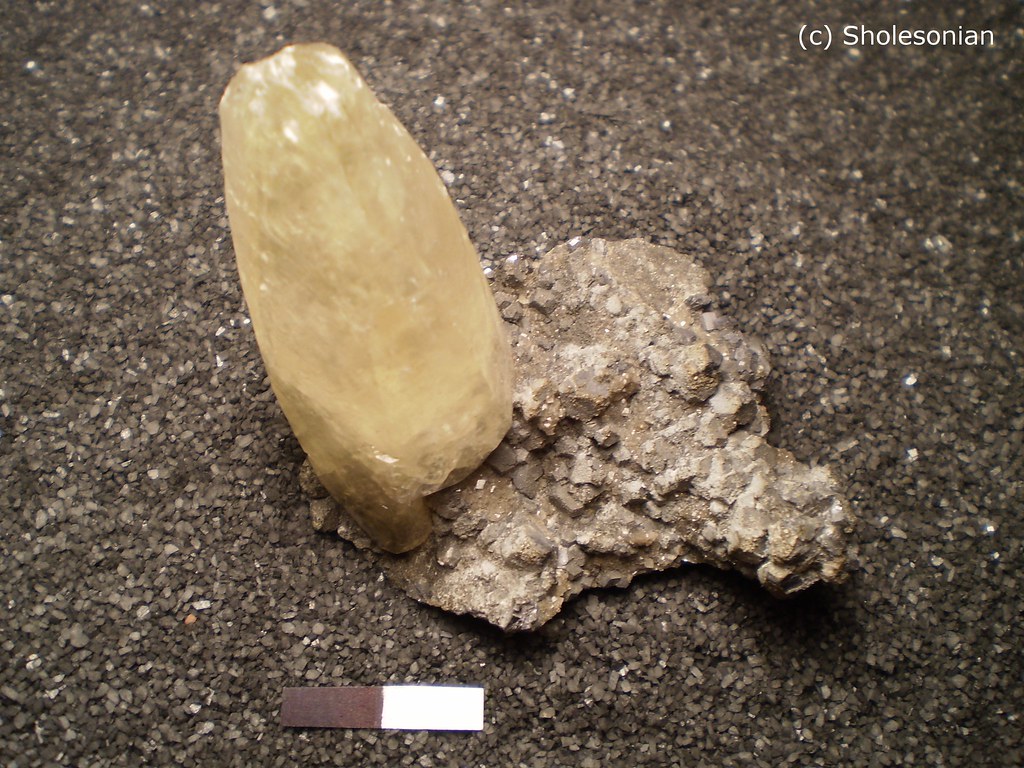
Calcite on Galena
Class: Mineral
Location: Reynolds Co., MO

Just a quick interesting post for today. I'm not going to go into the details of either calcite (the mineral that makes up the one large yellowish crystal) or the galena matrix it sits on, though I have separate specimens for both of them and will post them on a subsequent date. 

But you should all be excited! This past weekend the Sholesonian acquired a very large collection of minerals of all sorts, sizes, colors, and types so expect a large array of very interesting and display worthy specimens floating out of the Geology Collection. This brilliant piece was originally part of the R.M. Eaton Collection from Rochester, New York. The calcite is part of the carbonate mineral class whereas the galena is a sulfide mineral. So enjoy this great piece and the many more to come!

Monday, July 18, 2011

Index Mineral - GEO 056


GEO 056
Kyanite 
Class: Mineral
Location: Brazil

It's another scorching hot day here so just a quick post to hold you over. This is a nice larger mineral specimen heralding all the way South from Brazil. Kyanite is its name and it gets its name from the Greek word meaning 'blue' (for obvious reasons). Though don't take it that all Kyanite is blue, like many other minerals it can have a variety of color shades. This one also comes in white, gray, green, and black, though blue is the most commonly found type. Remember that to identify minerals you can't just use the physical properties (i.e. color/shape/taste in some cases but don't go around licking rocks), you must also use the properties such as hardness, streak (the color produced when rubbed on a streak plate, it's not always the same), density, crystal lattice, and of course chemical composition. Kyanite is made up of Aluminum (Al), Silicon (Si), and Oxygen (O) with a chemical formula of Al2SiO5. It has fairly good cleavage (roughly meaning it forms sheets), has a hardness of between 4 and 7 on Moh's Scale of Hardness, a white streak, and has a fibrous habit for growing. 

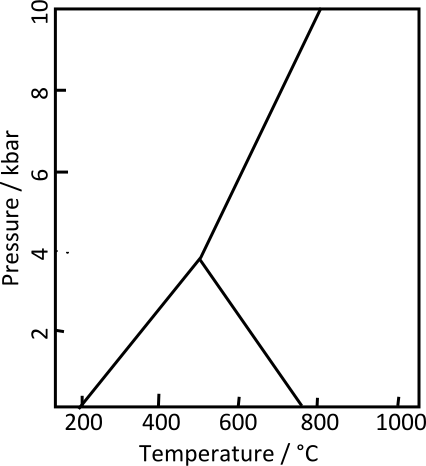
What's interesting about Kyanite is that it's an index mineral. Much akin to how index fossils are used for relative dating of the surrounding fossils, this mineral is used for finding the approximate temperature/pressure of the surrounding rock. This is because Kyanite is normally found in metamorphic rocks and is normally found above 4kB of pressure. If you take a look at this metamorphic mineral phase diagram, you can see that the triangular shaped chunk in the upper left-hand corner is Kyanite and if you know what the temperature is and you find a certain mineral you can estimate the pressure, or if you know the pressure and a mineral you can estimate the temperature at which it formed, though this is just a rough sketch of how to use it. It's other main uses include being used in dishware and electronics. And as always you can find more information concerning this interesting mineral Kyanite here. 

Tuesday, June 21, 2011

Fire Wash Fuzz - GEO 029


GEO 029
Pyrolusite
Class: Mineral
Location: New Mexico

Here's a very interesting new addition to the mineral collection at the Sholesonian. This is known as Pyrolusite, and despite it's small size it is different from all the other specimens. Pyrolusite comes in a variety of forms such as botryoidal, columnar and tabular but this is the common black fibrous form. Coming from New Mexico this mineral consists of Manganese and Oxygen (MnO2) making it an oxide mineral.


Here is some interesting geological information taken from this pyrolusite information page:
"A common Mn mineral, although difficult to distinguish from similar Mn minerals, pyrolusite forms under oxidizing conditions and high pH. Mainly a mineral of lacustrine, shallow marine, and bog deposits, it is also found in the oxidized zones of manganiferous ore deposits and as deposits formed by circulating meteoric water. Both colloidal processes and bacterial action are important in its formation."
It can have a wide range of hardness on Moh's Scale ranging from 2 to 6.5. The name pyrolusite comes from  Greek, meaning fire (pyro) and wash (lusite), which is named such in its use to remove tints from glass. 

This mineral also had a hand in the discovery of chlorine gas. When applied with hydrochloric acid the mineral reacts with the acid and produces chlorine gas as a product. Other uses include making a battery (albeit not a very powerful one) and as a dye. 

Monday, June 6, 2011

Impact! Rock - GEO 007


GEO 007
Tektite
Class: Meteorites and Kin
Location: Vietnam

To celebrate finally getting back up and running after this month hiatus I'm going to present a very interesting piece that has to do with my forte: astronomy. This specimen is called a tektite or as a mineral Indochinite (named after where it is found: Indochina). You see when a meteorite falls from the sky it is moving at such a large speed that the impact can be explosive. Some impacts can be hundreds of times the energy of a nuclear bomb. This impact creates intense heat and the rock that isn't instantly 'vaporized' or blasted from the scene melts from the heat and can fly through the air cooling down and re-solidifying. This is a type of metamorphic rock called impactite. As the rock flies through the air and cools down it forms this typical tear drop shape. 

This particular specimen comes from Vietnam and this is the small helpful data found on the label it came with:
"Tektites are formed when a huge meteor collides with the Earth with such force that melted rock and meteorite are thrown at high speeds into the upper atmosphere. Here they cool and harden, preserving their splashed, melted shape. Tektites are found in areas that are sometimes thousands of miles across. These particular specimens are jet black and come in a variety of shapes and sizes. Some show aerodynamic ablation indicating high velocity flights through the Earth's atmosphere."
A very interesting and cosmic piece to add to the growing collection at the Sholesonian for sure. And be sure to check out this Tektite informative page. 

Friday, March 25, 2011

(Left) Eye of the Tiger - GEO 070


GEO 070
Tiger's Eye
Class: Mineral
Location: Africa

I'm trying something new here so if you haven't yet check out Part I of this Tiger's Eye post, a kind of before and after. In Part I we looked at a specimen of Tiger's Eye from Africa that was polished whereas here we're looking at the straight from the earth raw material. As it was briefly mentioned in the other post, this mineral is actually another form of quartz, however its still very different from most other specimens like the citrine posted earlier. This is because its formed by pseudomorphous replacement rather than by just growing crystals.

As you'll notice in just about all examples of Tiger's Eye there are a lot of stripes, not just the larger ones but if you look closely you will see lots of very thin strands up and down the piece. This is because the mineral starts off as Riebeckite, specifically Crocidolite which is a type of asbestos and is also blue. It forms naturally and has these very thin strands of mineral, hence being an asbestos. What happens is that the mineral silicon dioxide starts to replace the minerals in the crocidolite, basically turning the asbestos into quartz. Once the pseudomorphous replacement has been completed the mineral Tiger's Eye will be left.

Both specimens GEO 053 and GEO 070 are from Africa according to their labels but they are more than likely not from the same place. Generally Tiger's Eye is mined in South Africa but that doesn't mean that these two specimens were. I'm just putting it out there so people don't think that because I'm connecting these two specimens that they have some sort of link. They don't other than that they are the same species of mineral. One is polished the other is not.

Learn more about Tiger's Eye.

GO TO PART I.

(Right) Eye of the Tiger - GEO 053


GEO 053
Tiger's Eye
Class: Mineral
Location: Africa

To try something a bit different than usual, this is Part I post of a two specimen post; check out Part II here. Tiger's Eye is a well known gemstone with its striped orange-yellow-brown-ish coloring and is apparently the 'planetary stone' for those born under Gemini and is apparently the gemstone for those celebrating their 9th anniversary. I'm generally not one to collect polished stones for the collection, the best pieces of geology are those found raw in their natural state. This is a very cool piece though, so I made an exception to get it.

Historically this gemstone has been believed to bring spiritual and physical health to the wearer along with providing clarity, psychic protection, and good business. However, this is all just superstition and shouldn't be bought into. There are also a few varieties of Tiger's Eye, specifically Tiger's Iron which is a rock rather than silicate mineral, and is made of jasper and hematite. As you'll see in Part II where I talk more about how Tiger's Eye is made, there is a type of the mineral that doesn't complete the process which can lead to Eagle's Eye which is much bluer than it's mammalian cousin.

Learn more about Tiger's Eye.

GO TO PART II.

Thursday, March 17, 2011

Chessy Blue - GEO 005


GEO 005
Azurite
Class: Mineral
Location: Arizona

So if you haven't already you should check out The Sholesonian over on Facebook to get the latest feed on new specimens and what's going on in the museum. Today's collection piece is a nice sample of azurite. This blue mineral is fairly common and is popular due to the rich blue hue it has. This popularity dates all the way back to the 4th dynasty of Egypt (this is the time when the Great Pyramids were being constructed), where the mineral was powdered and its pigment used for coloring. Now the mineral is used as an indicator of copper ore (the chemical composition of azurite is Cu3(CO3)2(OH)2) and it's used by a variety of crafters and jewelers.

Azurite has a hardness of about 3.75 on Moh's Scale and is roughly four times as dense as water. The mineral also will occasionally be referred to as Chessy or Chessylite after a French mine where many high-quality specimens where found. This particular piece, however heralds from Arizona, USA and is not most pristine specimen. Very nice pieces will show off azurite's conchodial fracture (think rounded crystals) whereas the crystals in this piece are substantially small, but it still has that great signature azure color. More specifics can be found at this very informative azurite page.

UPDATE: Found the label which has plenty of extra information on the locality of this piece. It was found at the 4,750 Feet Level at the Phelps Dodge Morenci Mine in Morenci, Arizona, USA. 

Thursday, March 3, 2011

Citrine not Citrus - GEO 012

GEO 012
Citrine
Class: Mineral
Location: Unknown (Eastern NY?)

Just as a heads up, I've been slowly converting older pictures to the new style with the scale and copyright on the sand. Also, let me know what you think of the new style and layout of the page. There is now a sidebar that displays the latest comments, which is up as a test for now. Anyway today's a specimen from the Geology Collection and while I'm not positive on what mineral species it is I've got it down to a few culprits. Due to the color and structure I'm going to go out on a limb and say this is citrine (a yellow/orange variety of common quartz). However I feel that this could also be fluorite, but for now I figure it to be citrine.

Quartz (SiO2) is a very common mineral and I'm fairly certain many of you all have seen quartz in one of its many forms. When it's purple it is known as Amethyst, pink is known as Rose Quartz, black forms a cool looking Smoky Quartz, and Milky Quartz is probably the most abundant (in Central New York at least) in its pure form (it is, surprisingly, white). As it turns out many citrines actually start out as amethyst but when heat is applied within the Earth the color will change into citrine. Because it is actually a quartz, citrine has the same hardness on Moh's Scale of Hardness: a 7. The location of this specimen is hazy, I received it as a gift and it was purchased at a shop on a mountain, but I'm not sure if it came from a site on the mountain or was imported from somewhere else. So it is temporarily from Eastern New York but that is very sketchy. If you want to learn some more about November's birthstone citrine.

Saturday, February 19, 2011

Lead, Iron, Antimony, Sulfide, Oh My! - GEO 003

GEO 003
Jamesonite
Class: Mineral
Location: England

Wow, it's been nearly two weeks since the last update, so I apologize for falling behind by schedule of at least one per week - it always seems to be too busy around here. Anyway it was suggested that I post up something from the Geological Collection today so I present to you all: Jamesonite. Now what's odd about this particular specimen is that while I have a label claiming it to be said mineral, a little research has made it seem less and less like actual Jamesonite. As you can see from the above photograph my specimen is a fairly heavy chunk of metallic 'rock.' Whereas if you look at this Jamesonite photograph (the fibrous metal looking stuff in the middle), they are pretty different. This is not to say that my specimen is mislabeled at all, as there is always a vast array of differences between specimens, but I still hold some questions in the back of my mind. Also, I'm not judging solely based on that photograph but also from the description on this Jamesonite mineral data page.

Anyway, this specimen comes from the small fishing village of Port Isaac in Cornwall, England. The label also mentions Treore but I'm limited in what I can find on what exactly that means. The mineral species itself contains lead, iron, antimony, sulfur and is a part of the sulfide group of minerals. While rating fairly low on Moh's Scale (~3) it does have a decent specific gravity of around 6. And as mentioned earlier usually the mineral forms fibrous crystals that almost look like hair or it grows similarly to the mineral Stibnite (One of my favorite minerals). So enjoy this unique piece and check out the up-close view posted down.

Tuesday, February 1, 2011

Pb and No J - GEO 046 *C

GEO 046 *C
Lead Sheet
Class: Elemental
Location: Man-Made

A few days back I posted a "What's Going On" entry where I had you guess what this particular specimen is. What you may notice is that the Sholesonian Identification on this piece is a bit different than others in the Geology collection. You see I didn't quite have a place for this piece to go. If you haven't noticed yet this gray sheet is a slice of some malleable lead (Pb, which stands for the Latin name plumblum). And this specimen doesn't really belong anywhere in the Collections I've set up. It's a man-made sheet so it doesn't quite belong in Geology but seeing as it once came from the Earth I'm going to place it there but create a subsection of pieces of a more Chemical nature.

Some brief information on lead is that it's atomic number is 82 and is a heavy metal. I have to be careful with this specimen as lead poisoning is a serious risk for animals which can lead to nervous system and brain damage. There is a lot of more in-depth chemical information on the lead page. However, for those who want a little more excitement when melted, one can dip their hand in some cold water and then immediately in the molten lead for a short time without any damage. This is due to the Leidenfrost Effect, where the heat from the lead is used to evaporate the water on the hand first creating a thin layer of steam which will protect your hand from burning and poisoning for a very short amount of time. I advise people to not try this but rather check out the MythBusters Molten Lead Experiment instead or this CSI Physics site on the science behind dipping your hands in molten lead. Enjoy!

Sunday, January 16, 2011

Cu Later - GEO 034

GEO 034
Native Copper
Class: Mineral
Location: Michigan

Oh wow, so apologies again for not posting in awhile but I've basically been gone all week. But last week I went to the King Tutankhamen exhibit down at Times Square then headed over to the American Museum of Natural History for the rest of the day. It was quite awesome and I'd tell you all to check out the exhibit, but it closes tomorrow and then Tut's artifacts are going back to Egypt to stay. But in March, Discovery is having a Pompeii exhibit starting in March so hopefully I'll be going to that as well.

Anyway, I'll post a fairly neat looking mineral for today. I'm sure you could probably guess what this piece really is, it looks almost like gold but with a coppery color. Of course this is copper in its native form. This particular specimen is from closer to home than most of the other geology collections. It was dug up in the Caledonia Mine in Ontonagon County, Michigan. And I just checked out the Caledonia Copper Mining Company's website and have to say it looks like fun. If you sign up ahead of time they will give you four hours to dig through a large pile of excess ore (for free) and you can keep any treasures you find. So I really want to check this out now.

Copper on the other hand occurs in this native form before it's melted down to make pipes and other useful items. Seeing as it's a native element it should come as no surprise that its chemical composition is simply Cu (also if you're wondering why copper is Cu it's because its Latin name is cuprum). It is fairly weak, only registering between a 2.5 and a 3 on Moh's Scale of Hardness (10 being diamond), but it has a fairly decent specific gravity with a density of 8.94 (water being 1). If you want to learn more, such as crystal structure and such check out this copper data page.

Tuesday, December 28, 2010

Rojo Eh - GEO 046

GEO 046
Red Mica
Class: Mineral
Location: Canada

So I hope everything went well over the weekend for those who celebrated Christmas and I got a brand new camera that has a super zoom and focus so expect some very nice pictures for the smaller objects in the museum. Also, it has a nice feature that allows me to draw a line and it gives me an exact measurement of how long it is. So I grabbed the first thing I saw in the museum that had a label and presto I present you a nice Red Mica specimen up from our neighbor to the North: Canada.

Now for those of you who know a thing or two about minerals will know that mica is just a broad term for a variety of minerals usually demonstrating very nice cleavage - meaning that they break along straight lines and in this case nice flat planes. There are two micas that are most well know, muscovite and biotite and they have a variety of uses. That being said I don't have the necessary equipment with me to determine the exact nature of this particular mica but a little bit of browsing the internet has me believing it to be Phlogopite.

If this red mica is in fact phogopite then its chemical composition is K(Mg,Fe,Mn)3(AlSi3O10)(F,OH)2. Micas are quite a useful mineral and are used in making capacitors for electrical components. If you would like more information on this particular red mica check here.

Saturday, December 18, 2010

Mercury Sulfide - GEO 026

GEO 026
Cinnabar in Calcite
Class: Mineral
Location: Mexico

Well it's been about a month since I last posted something from the Geological Collections so here you guys go, it's not 'pretty' by any means but is somewhat interesting. Now this particular mineral specimen is known as Cinnabar as is a mercury sulfide, being that its chemical composition is HgS. cinnabars are normally more reddish in color but can also be transparent/translucent like this particular piece. But this chunk is actually cinnabar in calcite, which is actually another fairly clear mineral.

I got this mineral from an estate sale in Walworth, New York and the actual specimen comes all the way from it's original location of Chihuahua, Mexico. Now more information about this mineral species can be found at this cinnabar data page. There you can find some normal mineral information, such as its specific gravity of 8.1, its hardness of about 2-2.5 (which is pretty low on Moh's Scale of Hardness; Diamond is the hardest and is a 10), and it has a bright red streak when used on a white streak plate.

Friday, November 19, 2010

Digging Deep - GEO 001

GEO 001
Drill Core
Class: Rock
Location: Unknown
Details: rock unknown

Sorry Sholesonian patrons, but I have been quite busy this past week and literally have not had the time to write out any posts. It is now finally Friday, so I have a bit of time to write up this post that was supposed to be for Wednesday, but studying got in the way. Now unfortunately, today's specimen has no locality or identification information at all because I purchased it at the same Newark, New York yard sale that I got the 'Peach Fuzz' piece from. So there were plenty of cheap large and interesting rocks/minerals but most no longer had any sort of label making them essentially worthless for a museum but very nice to look at and useful for teaching.

This piece from the Geology Collections is a drill core sample from some unknown locale. Drill core samples are very important for collecting scientific data. They are used predominantly in geological surveys to determine the strata layers and collect samples of deep rocks in the crust. But they are also heavily used in the oil industry, where the oil companies hire geologists to find the best places to drill for oil, so they use these rather long rock samples (this one is only 26 cm but they are usually feet long) to determine the makeup of the rock layers.

Monday, November 8, 2010

Elementary Geode - GEO 008

GEO 008
Geode
Class: Geodes
Location: unknown
Details: unknown mineral

So, today is just a boring post. It's a geode that I've had since sometime in Elementary School, so it's been in my collection for a long time. But anyway, when I first got it it was completely closed and I had to smash it open myself. It isn't the greatest specimen (the crystalline structure isn't that spectacular inside), but it is always cool to be the first person to see what the geode looks like on the inside.

Now, I'm not positive of what the mineral is that constitutes the crystals inside. If I had to guess it would be that it's some milky quartz (SiO2) but seeing as I haven't spent too much time looking it up and I don't know where it originated from so this is just my educated guess for the meantime. But because of the almost botryoidal behavior (roundish and looking like grapes), I think it may be something else. This round like crystal structure is something that does make it interesting in the collection. And if you're wondering how large it is, it's approximately the size of a golf ball.

Monday, November 1, 2010

Wollaston's - GEO 006

GEO 006
Wollastonite
Class: Minerals
Locatin: New York, USA
Details: has garnets

I haven't posted up any of the more display type minerals yet so here is one of them, albeit a tad boring due to it's lack of color. This is called Wollastonite, named after W.H. Wollaston, and has the chemical formula of CaSiO3, making it a silicate. It was originally retrieved from somewhere in New York, but judging from the fact that it is made in metamorphic processes I'm guessing the Adirondack Mountains area. I purchased it at a Rock and Gem show in Newark, New York and picked this guy out because of how similar it looks to salt and pepper. Thought it was an interesting specimen. The fact that it has those garnets also leads to my belief that it was found in the metamorphic region of the Adirondacks.

Anyway, the original label had 'Garnet-Diopside' written on it so I am guessing that the black specks, the pepper if you will, are those garnets as wollastonite is generally white, the salt part. In general however, wollastonite is used in ceramics and paints. It actually isn't all that interesting a mineral but its uniqueness comes from that interesting color combination. And I just learned from this site that the 'hot spot' for wollastonite in New York is Willsboro, which is right on the Northeastern edge of the Adirondacks, confirming my suspicions.

Oh, and happy first post of the month!

Friday, October 22, 2010

Non-Desert Dunes - GEO 009

GEO 009
Jockey's Ridge Sands
Class: Sands
Location: Nags Head, North Carolina
Details: largest Eastern US sand dunes

So today is one of my favorite geological pieces in my museum, sands from the largest sand dunes East of the Mississippi River. A few years back, 2006 I believe, my family and I went on a vacation down to the Outer Banks, North Carolina. The Outer Banks, encompasses a few towns, most notably Kittyhawk where the Wright Brothers had their first flight (I also got to check out where they flew). One of those towns is Nags Head which contains these massive sand dunes. Jockey's Ridge State Park is where they are mostly located so we spent some time there and it was pretty awesome. Though there is a ton of sand, and it gets everywhere, and you start sinking into it as you walk.

But anyway, while there I of course had to get myself a sample of them (scooping it up with an empty film bottle). So what you see here are those sands in all there glory. I particularly enjoy this specimen because of how nice it looks in the vial and how cool it is to have part of the largest sand dunes in the East. This is one of the special pieces of my collection, that is pieces that are from important or significant places/people in history/the world. Oh and I included a photo of myself showing off how big these dunes were. And if you want more information check out the Jockey's Ridge State Park website.