Showing posts with label Fossils. Show all posts

Thursday, March 8, 2012

Sea Scorpion - Fos 126


FOS 126
Eurypterus lacustris
Location: Buffalo Area, NY
Age: Silurian

And the Sholesonian finally has a Eurypterid for the fossil collection! These creatures are otherwise known as 'sea scorpions' and populate New York rock formations from the Silurian (~440 million years ago)! So much so that the species Eurypterus remipes has become the state fossil. These were the largest arthropods to ever exist with Jaekelopterus rhenaniae reaching sizes of 2.5 meters (that's about 8 feet tall!), however most species reach average lengths comparable to this specimen.

These fierce bottom-dwelling predators first appeared in the Ordovician (460 million years ago) and lasted for another 210 million years before they went extinct along with over 90% of marine life at the end of the Permian.  Contrary to their name, many species lived in freshwater areas or brackish water (a mix of salt water and non-salt water, i.e. less salt than marine environments) and are more closely related to horseshoe crabs than they are scorpions. This specimen of Eurypterus lacustris can be distinguished from the most common and closely related species Eurypterus remipes, as these have eyes that are further back and has a narrower metastoma (the tail-like appendage).

This particular specimen comes from the Williamsville (A) Formation of Western New York and is a negative impression. I had been searching for a good quality specimen that showed both swimming paddles, and was able to acquire this piece after receiving a generous graduation gift years ago that was earmarked for a fossil. There is a plethora of information available on these guys so check out the eurypterus page to give you a head start. Also, for those in New York, the Paleontological Research Institute has the largest complete eurypterid specimen on display if you get a chance to check it out.

Photo: Ohio State Geology Department

Saturday, October 15, 2011

Boring (Into A) Shell - FOS 034


FOS 034
Whelk
Sinistrofulgur contrarius
(?Busycon contrarium)
Location: Virginia-Florida
Age: Pliocene

Continuing with the mass posting to celebrate one year of the Sholesonian, we have this interesting fossil snail shell specimen. Normally I try not to pick up any fossils that don't have location data attached with them, they lose their scientific importance without it, but this one has an interesting feature that makes it a nice new addition to the Fossil Collection. 

If you take a look at the photograph of the shell you should see a lot of cracks in the shell. At first glance you may think, as did I, that these are just stress fractures from it breaking over time. But as it turns out these are actually quite different. These cracks were caused by another animal that was boring into the shell. Whether the snail was alive or deceased when this was happening isn't quite clear, but either is a possibility. The two possible culprits for doing this is either Cliona (a boring sponge) or a bryozoa (a moss animal). 

As for the shell itself, I've been told that it belongs to the genus Sinistrofulgur, which through some looking up seems to be now a part of Busycon. It's most likely Pliocene in age, meaning that this is a relatively recent fossil, only a few million years old. These snails are equipped to drill holes into their prey, usually bivalves, and eat the insides if they are successful. This particular shell is left-handed. And yes while snails don't have hands they can be either right or left handed. To figure out which a snail is hold it up with the point of the spiral up and whichever side the opening is on decides which-handed it is. If you mentally rotate the picture below 90 degrees clockwise you will see it. 


Wednesday, July 20, 2011

Grammy! - FOS 030


FOS 030
Bivalve
Grammysia sp. 
Location: Lansing, New York
Family: Grammysiidae

Here is a great brand new addition to the Sholesonian's fossil collection, and it's been identified to boot! This specimen is a fairly large bivalve (think clams and others in the class Bivalvia) that is from the Middle Devonian which started around 397 million years ago; 397,000,000 years!! It was recovered from the Hamilton Group, Moscow Formation in Lansing, New York just yesterday. 

What is cool about this specimen other than it's size and great preservation is that this is a burrowing bivalve. Thus it goes into the sea floor sediment to live and was eventually buried for good, whether it was alive or not is another question (though probably not). I unfortunately don't have too much more information on the Grammysia genus, but it's still a very cool specimen. Also, shout out to our graphic designer Rachel for taking my photograph and revamping it up to a more professional level. Enjoy!

Wednesday, June 15, 2011

Phacops - FOS 024


FOS 024
Phacops Trilobite
Phacops rana
Location: Lansing, New York
Family: Phacopidae

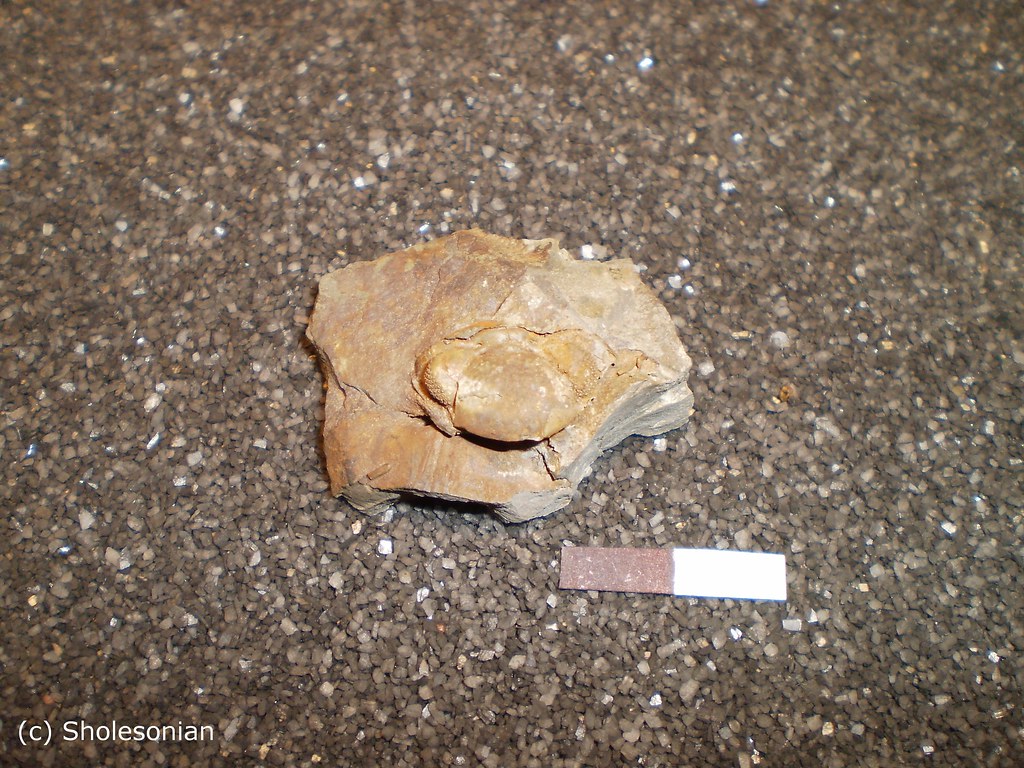
So I just got a trilobites of New York book and have been looking to identify some of the many trilobites in the collection in the coming weeks. While I'm not completely positive that this is indeed Phacops rana I have a good feeling that it is. This species is one of the most recognizable trilobites due to their large eyes (in fact the species name P. rana is a reference to the giant eyes of frogs), as well as one of the most common in New York state. This particular specimen was found in Lansing, New York which is part of the Hamilton Group, Moscow Formation which contains fossils from the Middle Devonian Period which started some 416 million years ago. This geologic period is widely noted for the abundant fish, including the armored placoderms such as the fierce dunkleosteus. 

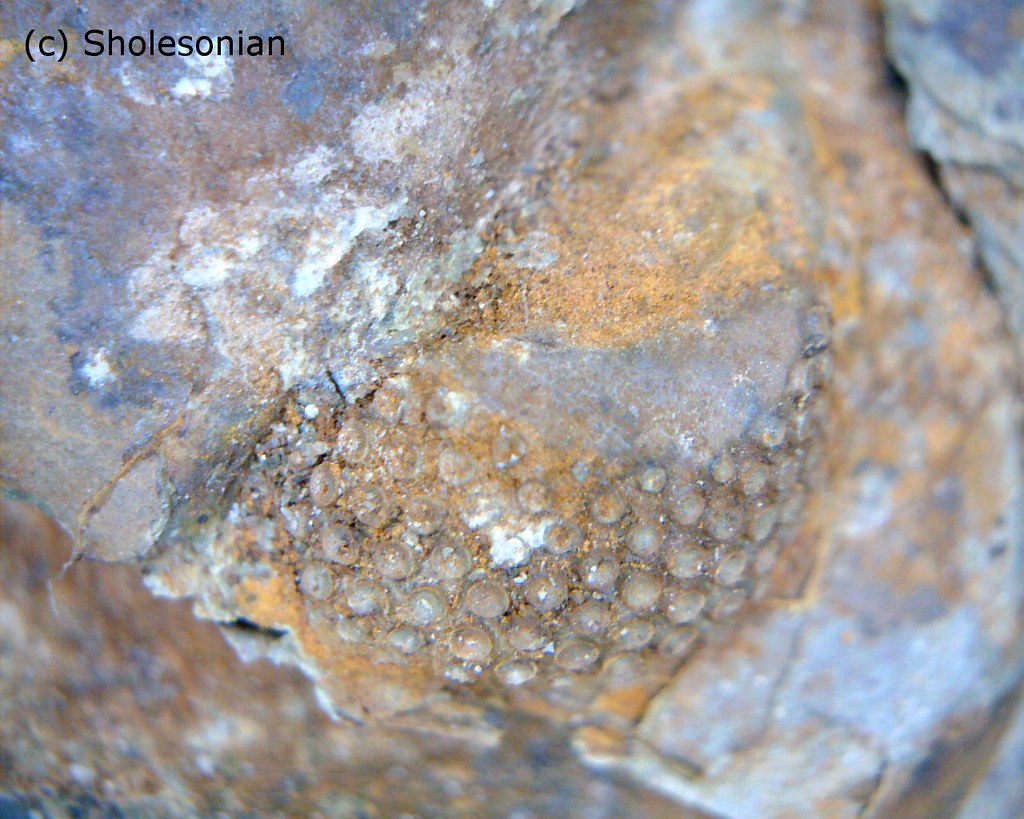
It's a little hard to accurately identify this guy as 1.) I am not an expert on trilobites, and 2.) this is only the cephalon ('head') and doesn't have the rest of the animal (i.e. thorax and pygidium). However as the trilobite book says this is the most common trilobite found in New York. While not always found this way, these creatures could roll up into a ball like 'pill bugs.' You can get a brief introduction to these guys here at this Trilobite information page. And since these guys are most well known for their eyes I took a close up picture for you to enjoy.

UPDATE: This site is actually part of the Hamilton Group, Moscow Formation which includes fossils from the Middle Devonian. 


Tuesday, June 7, 2011

Leafy Imprints - FOS 017


FOS 017
Fossilized Leaves
Location: Idaho
Family: Unknown

Fossils are a bit tricky for me to identify families/genera/species so I'm going to have to leave this identification for a later date (did you get the pun in there?). Anyway this is a small but well preserved leaf fossil from Early Eocene Epoch some 50 million years ago. It was dug up as part of the Salmon River Flora in Lemhi County, Idaho. During this time period the Earth was actually warming up and keep in mind that despite being 50 million years old this is relatively recent period as the continents were very close to their present location. You can check out an Eocene Map here. And to give you a reference point the Cretaceous-Tertiary Extinction event (that's what killed off the dinosaurs) was 65. 5 million years ago. 

Now I just did a little research about fossil leaves found in Idaho and I've narrowed it down to two probable genera. I am going to go with Betula which are the birches, however since I'm not a botanist I'm not positive that it can't be Alnus or the alder trees. But this leaf looks more like a birch than an alder in my opinion. If you want to learn more about fossils in general or even more specifically the fossils of Idaho check out this site which gives a very good overview of the fossilization processes and what kinds of fossils can be found from the different geological periods. 

Sunday, March 27, 2011

Stomach Stone - FOS 021


FOS 021
Gastrolith
Location: Utah
Family: N/A (Trace Fossil)

As I continue to procrastinate here is an interesting specimen that looks like nothing until you realize what it is. Heralding from the Morrison Formation out in Utah (meaning this is from the Upper Jurassic: 161-145 million years ago) this is a type of trace fossil, called a gastrolith, from a dinosaur. The term gastrolith comes from Greek meaning 'stomach stone' and with good reason. Much to how many modern day birds and other animals will require swallowing stones or pebbles in order to 'chew' their food (due to lack of teeth), so did the giant sauropods of the Jurassic/Cretaceous. While they did have teeth, their function was purely to grab a hold of leaves and other vegetation and not to chew (like our front teeth) and they would swallow their meal whole, along with some rocks. These rocks would grind up the food in their stomach (or rather gizzard which is a specialized stomach of sorts) preparing it for digestion. Afterwards the stones would easily pass; as you can see they would round out in the grinding process. 

While this particular specimen was probably used by a giant sauropod (the long-necked dinosaurs) it could have been from any sort of dinosaur that lacked suitable teeth for chewing. Plesiosaurs and their kin have also been known to swallow stones, but to be used as ballast rather than grinding. This means that one would swallow a few to balance them in the water much to how modern day alligators and crocodiles do today. And as it turns out the Morrison Formation where this specimen was found has a long documentation of gastroliths mostly from sauropods of the old old west. And some have even been known to actually be petrified wood. So another interesting fossil from the collection, and you can check out more about gastroliths here. 

Sunday, March 20, 2011

Polished and Permian - FOS 019


FOS 019
Goniatite
Location: Unknown
Family: Goniatitidae

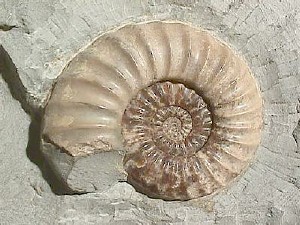
This is a very nice specimen that I received a few years back, but unfortunately I've seemed to misplaced the label so I have no idea where this particular fossil is from. However, I do remember the name of the creature: it's a goniatite. These things were very similar to the popularly known ammonites. While I'm not positive on the exact identification of the specimen I do know that it is at least in the Goniatite order and I'm taking a guess as to the family (Goniatitidae). 

Now I hope a few of you are somewhat familiar with what these guys would have looked like alive. If not the basics are that this is a chambered shell and the actual animal lived in the newest chamber, which in this case is the one in the lower left hand corner of the photograph. The rest of the chambers were filled with gas that functioned similar to the swim bladders in fish were it would make the goniatite buoyant in the water. You can really see the chamber structure right were the white portion meets the darker section (as the goniatite grew it would build new chambers). The animal had a bunch of tentacles that would come out of the last chamber along with two eyes and a head. They lived during the Mid-Devonian up until the Late Permian in oceans and were evidently not the best swimmers in the sea. 

There's a lot more cool information you can find about these very nice specimens by doing a few quick Google searches, but you can find a little bit more information on goniatites here. 

Sunday, February 27, 2011

Rugosa - FOS 018

FOS 018
Horn Coral
Location: Hamburg, NY
Family: Zaphrentidae

Now I generally don't post up fossils because I want to be fairly certain with the label before I do so and don't have enough time or resources to do some appropriate research. However, while I am not completely positive on the identification I'm hoping I'm correct with the family name. These types of fossils are generally known as Horn Corals due to their horn like appearance (the smaller end was attached to the reef) but they also go as Rugose Corals.

Generally solitary animals (yes corals are animals), these extinct creatures would live in shallow seas and have tentacles that would come out of the top portion to trap and capture prey. While I'm not completely positive on what the family/genus/species is for this particular specimen but it is very similar to the Heliophyllum genus of corals. I'm not going to say that it is because I don't think that it is quite the same but there are some close similarities, for now we can just keep it as a Rugose Coral. It was collected at the Penn Dixie site located in Hamburg, NY back in August of 2009.

Wednesday, December 22, 2010

Moroccan Trilobite - FOS 013

FOS 013
Trilobite
Location: Morocco
Family: Calymenidae
Details: mounted

Well it's getting nearer to Christmas so here is a nice large trilobite fossil just for you. Now I got this particular specimen at a yard sale, pre-mounted, and it does have a note label on the back of the wooden plaque. This trilobite belongs to the genus Diacalymene, and the label doesn't offer any species name but my research seems to point that there is only one species in this genus that being D. ouzergui. So I'm betting that it belongs to that one. However it should be noted that these particular fossils are often confused with the genus Flexicalymene, so it is possible that whoever typed up the label got the two mix-matched.

Now the label also gives a brief description on this trilobite genus. It reads "These Silurian Period trilobites lived about 425-450 million years ago. Trilobites are extinct marine Arthropods having the body divided by two furrows into three parts and found as fossils in Paleozoic rocks. These large artifacts are excellent examples displaying well this Arthropod's structural detail." This specimen, as are most from this genus, was mined in Morocco (North Africa).

Tuesday, November 30, 2010

Atrypids - FOS 012

FOS 012
Pseudoatrypa Shell
Location: Ovid, NY
Family: Atrypidae
Details: only fairly certain on ID

I apologize for not posting anything in awhile, but I didn't have any of my materials/data over the extended Thanksgiving weekend (hope everyone had a happy one by the way), and this week is pretty busy for me so don't expect too many new posts in the coming few weeks. But I finally found out the family for one of my fossils, which is why I haven't posted too many fossils seeing as it takes a little bit of work to identify them. I've been working with bivalves recently at the PRI and in researching another genus I found a Fossil Site where I noticed a specimen that looked very similar to one in my collection.

The bivalve this professor collected was a Pseudoatrypa devoniana, and since I'm not an expert in this area and don't have too much time on my hands I am going to temporarily identify mine under the same genus Pseudoatrypa. It belongs to the Atrypidae family which I'm fairly confident in, seeing as the general characteristics are the same and location is also very similar. This one was found at Camp Babcock-Hovey in Ovid, New York back in 2008. There is a little more information on this genus at this paleontological site. They're stationary suspension feeders.

Sunday, November 7, 2010

Plant or Animal - FOS 011

FOS 011
Crinoid Segment
Location: Hamburg, NY
Details: part of the stalk

Here's just another short post from the fossil collection. This one is a crinoid stem that I collected myself from the Penn Dixie Site in Hamburg, New York back in late-August 2009. Most of the fossils that I found there were trilobites and rugose corals (horn corals). But occasionally I found some crinoid pieces or the occasional brachiopod there (they're more common to Central New York).

Now, this is the 'stem' part of the crinoid. You see while crinoids look a lot like underwater plants, they are in fact animals. You can see from this crinoid informational page what the actual structure looks like for these pretty interesting creatures. Crinoids are actually still around, though most modern day species no longer have a stalk and just float around the ocean. Like I said this is a pretty short post, mostly because I'm tired and crinoids are little too regular for me (i.e. I see them a lot in the fossils I collect).

Tuesday, October 26, 2010

Orthoceras - FOS 009

FOS 009
Orthoceras Chamber
Location: Morocco
Details: polished in matrix

So just a quick post before I go insect collecting (I've already added 5 new specimens to the collection today NH 056-NH 060). I haven't had a fossil post in awhile so I present you guys with my Orthoceras. These are fairly easy to identify and most people enjoy them as pieces of art as they polish up nicely. I generally don't like polished up specimens but I had to make an exception for this one as they are usually only sold polished and needed one for my collection. I bought this one at the Rock, Mineral, and Gem Show in Syracuse, New York a few years back.

Orthoceras' were cephalopods and you would probably recognize their body shape by clicking the link. I may have some additional details on this particular specimen back home, but I'll have to wait before I can verify any of that (I might have a label indicating where this specimen was originally found, which is important for scientific purposes). They lived between the Ordovician and Triassic periods, and fed upon small marine animals. They generally didn't grow to be too big, only about 6 inches in length.

EDIT: From Morocco, Devonian age.

Tuesday, October 19, 2010

Shark Attack - FOS 003

FOS 003
'Shark' Tooth
Location: Unknown
Details: animal unknown

So I decided the past few posts weren't all that interesting so I decided to present this fossilized shark tooth today. I unfortunately don't know the details from this fossil, but it is still a nice addition to the museum. It was part of a gift from my aunt, along with an array of minerals. I'm sorry I can't give any more details on this one but that is the extent of my knowledge on this specimen.

But if you guys want to learn more about prehistoric sharks you can check this link out. So enjoy this fossilized tooth from an ancient predator of the deep.

Wednesday, October 13, 2010

Monster of the Deep - FOS 002


FOS 002
Mosasaur Tooth in Matrix
Location: Unkown (Probably Morocco)
Details: Acquired at the Royal Ontario Museum

So I finally received my photo studio, to help with cataloging all of the collections. To start with I'm going to put up one piece from each of the collections, to give a little taste of what is here. To start off I'm going to be posting a newer specimen in the FOS collection. It's a Mosasaur tooth, theoretically that is.

You see, while I did acquire this fossil at a museum gift shop, I'm not too sure of its authenticity. As you can see from picture there is a severe lacking of pores/deep pockets in the matrix and the fossil, which leads me to believe that it may actually be a replica. Not to fear though as most of the real museums have many casts of fossils on display and not the real thing, so despite its questionable nature it still adds a bit of excitement to the collection.

A little bit about Mosasuars though to go along with the post. Despite ending in -saur, Mosasaurs are actually not dinosaurs. You can think of it this way, if it lived in the water it wasn't a dinosaur, this is also true for pterosaurs and their kin. It's technically all in the hips (the way the bones in that area are). Obviously from the size and shape of the tooth you can clearly see that this was the top sea predator of its time.

More Information