Monday, August 29, 2011

Morlock & Midnight Men! - PUB 070


PUB 070
Morlock 2001 and the Midnight Men
Media: Comic Books
Year: 1975
Details: Atlas Comics

Wow, it has been awhile since the last update, but here is a very interesting and comic comic. While I haven't collected any comic books before, this one seemed very interesting and obscure. Most of us have heard of the top comic book companies, DC and Marvel, but this is from the lesser known Atlas Comics. Worth only 25 cents when it was issued in July 1975, Morlock 2001 and the Midnight Men is the third issue of the Morlock series. However, Atlas Comics failed to capture enough consumers and was defunct within a year leaving even it's most popular titles with only four issues. 

Since I only have the third (and last) issue, I am unaware of a lot of the background story to the exact premise of Morlock, but I learned enough in this issue. The year is 2002 (!) and all forms of books are banned (similar to the storyline of Fahrenheit 451). Professor Whitlock's secret library  is burned down along with himself (at midnight) by the government for treason, while Morlock is questioning himself about transforming into his monstrous form in order to help the professor. Morlock is a guy who comes from a pod of unknown origin but was betrayed by the government scientists that raised him, and has the ability to transform into a monstrous plant/beast. He has extra arms, is extra big, his flesh is like a slimy mold that liquefies human flesh which he absorbs. 

After 'eating' the guards he fails to save the professor who burns up in the flames. But alas! The professor miraculously survives the inferno, but his entire body is covered in severe third degree burns, yet he feels no pain. He drags Morlock to safety and they go to the underground railroad (under former NYC) where there is an uprising of against the government 'The Tribunal.' The professor renames himself, in new uniform, Midnight Man and requires all those in the rebellion to dress up and be the Midnight Men. He plans to use Morlock and his powers to help fight the Tribunal. However, the government discovers their secret hideout and attack, but Morlock has no control over his powers and doesn't want to become a mindless beast once more. So to save Morlock, Midnight Man shoots and 'kills' Morlock and rushes off to fight the Tribunal forces. 

And that's it. The company did not make anymore issues as they were folded over. It should be noted that this particular issue was nearly a saving grace, as it became one of the more popular issues, yet not enough to save the company. If you want to learn more about Morlock 2001 and the Midnight Men check out this great website on the comics. 


Tuesday, August 9, 2011

Summer Symposium at the PRI

 So for those who didn't hear, the Sholesonian recently made a presentation on its collection and outreach effort at the Summer Symposium 2011 at the Paleontological Research Institute. I gave a brief overview on what I do with this site as well as giving a quick look on how to make your own insect or fossil collection. If you have any questions or want to learn more feel free to leave a comment here, on our Facebook page, or shoot us an email. I have made the presentation available for your viewing right here so enjoy!


Wednesday, August 3, 2011

Summer Buzz - NH 303


NH 303
Dog Day Cicada
Tibicen canicularis
Category: True Bugs
Family: Cicadidae

So I was shot a question the other day over the true nature of cicadas, and thus I am presenting one from the collection to quickly clear up some misconceptions. Sitting outside in the hot summer sun, you hear the most distinguishable sound of summer a loud buzz that encompasses the whole area. This is the work of the cicadas, a bug that is famous for its moltings and life-cycle. The insects themselves generally aren't seen (except as will be noted) but once they emerge from the ground the nymphs will shed their old 'skin' and leave behind the moltings, clinging to trees for us to find. 

This is where some confusion over these critters usually comes in. For those who are unaware cicadas are well known for their odd life-cycles. After laying their eggs in twigs the larva will make their way underground where they will stay for years at a time. The famous ones are the American 13 and 17 year cycle types of the Magicicada genus. This means that the larva will stay in the ground for 13 or 17 years, then will emerge in swarms, but within two months all the of them will die only leaving behind the eggs for the next periodical cycle to begin. 

However, this particular specimen isn't one of the extremely long term species. It's a common Dog-Day Cicada of the Northeast US, and this one is just an annual cicada. So rather than waiting in the ground for 17 years, the nymphs are only buried for a year where they feed on root juices. They all don't come out at once, but are distributed throughout July and August. And because the nymphs feed on the roots of trees they are known to be a pest.

Also, you may be wondering what is the point to having a 17 year developing stage only to live 'normally' for a summer? Well it's believed that emerging in one massive brood can overwhelm predators like birds. It is also thought that having such a long and prime-numbered life cycle makes it harder for predators to keep track of. As always here is an informational page on the Periodical Cicadas for you to learn more about their life cycles and how to deal them as pests. 

Wednesday, July 27, 2011

Official Logo!


So the time has finally come where we now have an official logo for the site! Special shout out thanks to Rachel who has graciously given her time to create this masterpiece.

As you can see, the six different sections represent our six different collections: an old bellows camera for our Historical & Cultural Collection, a Devonian trilobite for the Fossil Collection obviously, a beautiful butterfly marks our Natural History Collection, a chunk of quartz crystals stand for the Geology Collection, a simple U.S. quarter with the date of our founding for the Numismatics Collection, and last but not least a book open to the Sholesonian guide marks our Publications Collection.

Enjoy, and let us know what you think!

Tuesday, July 26, 2011

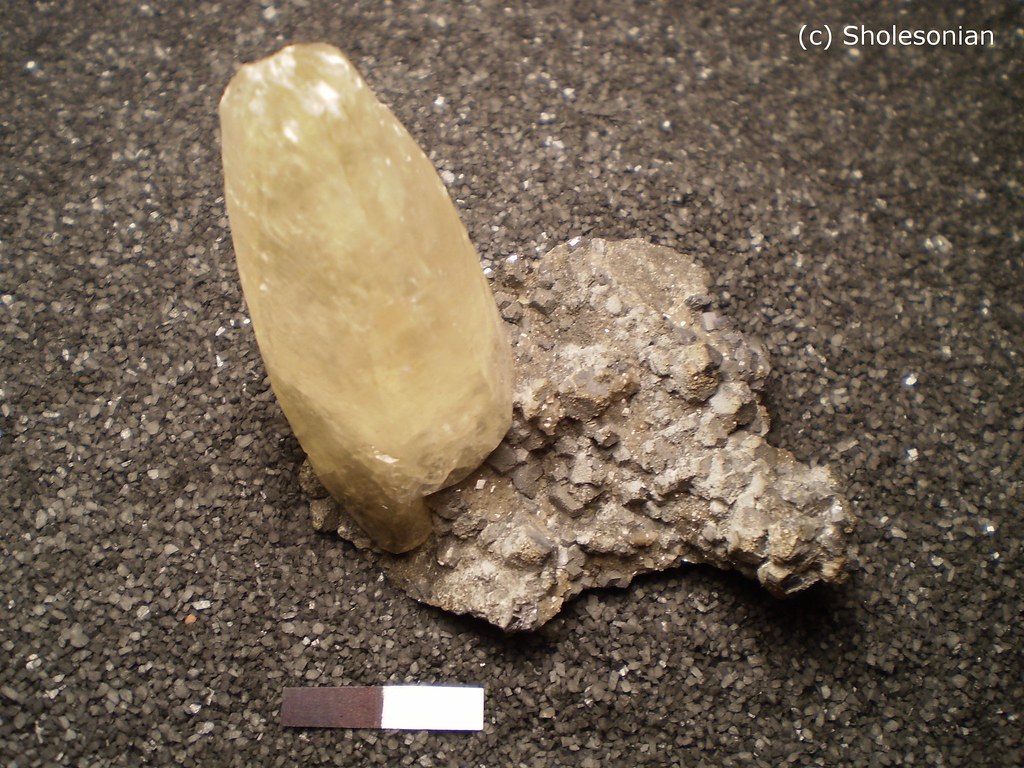
New Minerals! - GEO 082


GEO 082
Calcite on Galena
Class: Mineral
Location: Reynolds Co., MO

Just a quick interesting post for today. I'm not going to go into the details of either calcite (the mineral that makes up the one large yellowish crystal) or the galena matrix it sits on, though I have separate specimens for both of them and will post them on a subsequent date. 

But you should all be excited! This past weekend the Sholesonian acquired a very large collection of minerals of all sorts, sizes, colors, and types so expect a large array of very interesting and display worthy specimens floating out of the Geology Collection. This brilliant piece was originally part of the R.M. Eaton Collection from Rochester, New York. The calcite is part of the carbonate mineral class whereas the galena is a sulfide mineral. So enjoy this great piece and the many more to come!

Wednesday, July 20, 2011

Grammy! - FOS 030


FOS 030
Bivalve
Grammysia sp. 
Location: Lansing, New York
Family: Grammysiidae

Here is a great brand new addition to the Sholesonian's fossil collection, and it's been identified to boot! This specimen is a fairly large bivalve (think clams and others in the class Bivalvia) that is from the Middle Devonian which started around 397 million years ago; 397,000,000 years!! It was recovered from the Hamilton Group, Moscow Formation in Lansing, New York just yesterday. 

What is cool about this specimen other than it's size and great preservation is that this is a burrowing bivalve. Thus it goes into the sea floor sediment to live and was eventually buried for good, whether it was alive or not is another question (though probably not). I unfortunately don't have too much more information on the Grammysia genus, but it's still a very cool specimen. Also, shout out to our graphic designer Rachel for taking my photograph and revamping it up to a more professional level. Enjoy!

Monday, July 18, 2011

Index Mineral - GEO 056


GEO 056
Kyanite 
Class: Mineral
Location: Brazil

It's another scorching hot day here so just a quick post to hold you over. This is a nice larger mineral specimen heralding all the way South from Brazil. Kyanite is its name and it gets its name from the Greek word meaning 'blue' (for obvious reasons). Though don't take it that all Kyanite is blue, like many other minerals it can have a variety of color shades. This one also comes in white, gray, green, and black, though blue is the most commonly found type. Remember that to identify minerals you can't just use the physical properties (i.e. color/shape/taste in some cases but don't go around licking rocks), you must also use the properties such as hardness, streak (the color produced when rubbed on a streak plate, it's not always the same), density, crystal lattice, and of course chemical composition. Kyanite is made up of Aluminum (Al), Silicon (Si), and Oxygen (O) with a chemical formula of Al2SiO5. It has fairly good cleavage (roughly meaning it forms sheets), has a hardness of between 4 and 7 on Moh's Scale of Hardness, a white streak, and has a fibrous habit for growing. 

What's interesting about Kyanite is that it's an index mineral. Much akin to how index fossils are used for relative dating of the surrounding fossils, this mineral is used for finding the approximate temperature/pressure of the surrounding rock. This is because Kyanite is normally found in metamorphic rocks and is normally found above 4kB of pressure. If you take a look at this metamorphic mineral phase diagram, you can see that the triangular shaped chunk in the upper left-hand corner is Kyanite and if you know what the temperature is and you find a certain mineral you can estimate the pressure, or if you know the pressure and a mineral you can estimate the temperature at which it formed, though this is just a rough sketch of how to use it. It's other main uses include being used in dishware and electronics. And as always you can find more information concerning this interesting mineral Kyanite here.