Saturday, October 15, 2011

Boring (Into A) Shell - FOS 034


FOS 034
Whelk
Sinistrofulgur contrarius
(?Busycon contrarium)
Location: Virginia-Florida
Age: Pliocene

Continuing with the mass posting to celebrate one year of the Sholesonian, we have this interesting fossil snail shell specimen. Normally I try not to pick up any fossils that don't have location data attached with them, they lose their scientific importance without it, but this one has an interesting feature that makes it a nice new addition to the Fossil Collection. 

If you take a look at the photograph of the shell you should see a lot of cracks in the shell. At first glance you may think, as did I, that these are just stress fractures from it breaking over time. But as it turns out these are actually quite different. These cracks were caused by another animal that was boring into the shell. Whether the snail was alive or deceased when this was happening isn't quite clear, but either is a possibility. The two possible culprits for doing this is either Cliona (a boring sponge) or a bryozoa (a moss animal). 

As for the shell itself, I've been told that it belongs to the genus Sinistrofulgur, which through some looking up seems to be now a part of Busycon. It's most likely Pliocene in age, meaning that this is a relatively recent fossil, only a few million years old. These snails are equipped to drill holes into their prey, usually bivalves, and eat the insides if they are successful. This particular shell is left-handed. And yes while snails don't have hands they can be either right or left handed. To figure out which a snail is hold it up with the point of the spiral up and whichever side the opening is on decides which-handed it is. If you mentally rotate the picture below 90 degrees clockwise you will see it. 


Spider Wolf - NH 155


NH 155
Wolf Spider
Hogna sp.
Category: Arachnids
Family: Lycosidae

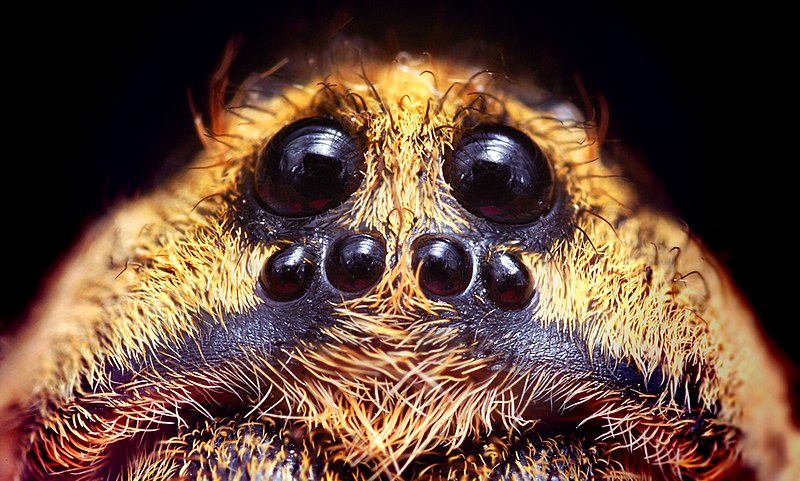
Spider Saturday is actually up on time today during our anniversary celebration! Those of you keeping up with the Facebook page may have already taken a quick look at this big local spider. This past May I was taking a walk and stumbled across this mean looking spider crawling across a path by the Johnson Art Museum at Cornell University. I happened to be carrying a capture cup with me and it just managed to fit inside after some difficult maneuvering. It did manage to escape on my while trying to preserve it and was running around my room, but I managed to recapture it without any harm done. 

This spider belongs to the family of wolf spiders: Lycosidae, and is of the genus Hogna. There are many species  in this group so without putting it under a microscope to examine its nether-regions. Wolf spiders are well identified by their characteristic wolf spider eye pattern. The mothers are also well known for carrying their newborn on their abdomen as seen in this Wikipedia photo. They generally come out to hunt at night and if you are looking for them shine a flashlight down looking for the reflections in their eyes. Don't worry, as big and bad as they look, they aren't poisonous and generally not harmful to humans. 

Ghost Music - PUB 072


PUB 072
Do You Ever Think of Me
Media: QRS Word Roll 1336
Year: 1920
Details: Sherman Clay & Co.

So it's been a busy past few months, but with excitement we celebrated the one year anniversary of our first post this past Thursday October 13, 2011! Over 100 posts after our first post I bring you another five posts to celebrate the event! First up is this nearly century old player piano roll with the song "Do You Ever Think of Me." It's a foxtrot with words by Harry D. Kerr and John Cooper with music by Earl Burtnett. You can check out the lyrics and even download for free what the song would sound like on the piano at the link above.

So, for those of you still in confusion, this song isn't ordinary sheet music. It's a roll  to be used in a player piano, those old pianos in the height of popularity during the 1920's that would play by themselves. Using the small punches in the paper the piano would be able to 'read' the music and play the tune without a need for a human player. At one point during the early 1920's half of the pianos being made in the country were player pianos. After the fall of the Roaring Twenties with the stockmarket crash the popularity of the player piano fell into deep decline. 

For those interested this is word roll 1336, and despite the song having lyrics, obviously the piano only played the music itself. Back when it was originally made the song itself cost $1.25, approximately $14.50 in today's economy. 

Family Day Fun!

Those of you not keeping tabs on our Facebook pages should enjoy knowing that our Family Fun Day exhibit was a complete success! On Saturday September 24, 2011 at Ithaca, NY's Museum of the Earth, the Sholesonian set up a table for their Family Fun Day. With a variety of treasures from all six of our collections, patrons were able to enjoy all the unique items. Check out the photos of the event below and click on a photo to enlarge it!


Monday, September 19, 2011

Spider Myths

So, as I try to balance my math and physics problem sets with preparing for my Family Fun Day table this weekend there aren't going to be any posts this week (hopefully to resume next week). But to hold you over here is a nice website dedicated to debunking all of those pesky arachnid related myths.

Do you actually swallow 8 spiders in your sleep per year?
Are daddy longlegs the most poisonous spiders in the world?

Find out at:

Spider Myths: Home:


* Also I may start using the 'Blog This' feature of Google Chrome to start just posting links to interesting scientific and historical findings that I come across. Let me know what you think.

'via Blog this'

Sunday, September 11, 2011

Golden Cube - GEO 141


GEO 141
Pyrite
Class: Mineral
Location: Spain

So, by popular demand I am posting up one of the brand new awesome minerals! For starters, yes this is really how it looks. It's known as a pyrite cube and Spain is famous for having these great crystal structures where the pyrite mineral forms large cubes like this one. Pyrite is more commonly called Fool's Gold due to it's gold coloring. While they usually don't come in these pristine cube shapes, most pyrite specimens have a distinct cubic pattern if you look really closely. Sometimes you will find very cool Pyrite disks which look like gold sand-dollars, unfortunately the Sholesonian does not have one in the collection, yet. 

Pyrite is about a 6 on Moh's Scale of Hardness, has a fairly high specific gravity (think weight/density), and is a sulfide mineral. The chemical composition of pyrite is FeS2, or just iron sulfide. It's name comes from the Greek, of fire, because it would be used to make sparks when struck against steel. You will often find fossils, even here in Central New York, where you get pyritization, pyrite crystals form and replace some of the fossil material creating a spectacular display of a golden fossil. There are a few other pyrite-similar minerals: Arsenopyrite and Chalcopyrite, both of which will eventually be posted up here later on. 

Thursday, September 1, 2011

MotE Event & Collecting!


As I mentioned earlier I was a speaker at the Paleontological Research Institute's 5th annual Summer Symposium talking about this blog and the outreach I have been doing. [You can see me in the bottom left-had picture in the red jacket.]

Anyway, I will be doing a small one-day exhibit over at the Museum of the Earth in Ithaca, New York on Saturday September 24th for their Family Day (and opening of the new Fossil Prep Lab which I have worked in before). I'll be there with some unseen pieces of the Sholesonian Collection while teaching kids (and parents, others, etc.) tips to having collections. You'll get some inside tips of the trade. 

I will also probably be giving another brief presentation on the Sholesonian at this event and as always will be glad to talk to individuals and families about pursuing collecting - whether it be fossils, insects, rocks, or memorabilia. And as always, leave a comment here, email us, or post on our Facebook wall if you have any questions about your own collection or just want to say hello! 


And as a side note, I am providing here a list of endangered, threatened, locally extinct, and species of special concern list for the state of New York. Please note that if you do collect shells/insects (or delve into taxidermy) to not capture/kill any of these species. We must protect our biodiversity and natural wildlife to [Dare I say it: Save the world! (I stole that from Bill Nye whom I just recently met)] This also means that you should not collect an excessive amount of any one species, even if they are very common (a lesson we should learn from the Passenger Pigeon). Hopefully I will print out a nice handout with picture of what not to collect for the event.